 Your post is being uploaded. Please don't close or refresh the page.




DALLAS — For renowned British engineer Stuart Burgess, the human hand, without question, is the "pinnacle of mechanical engineering.”
In a presentation at Park Cities Baptist Church as part of the Discovery Institute's eighth annual Dallas Conference on Science & Faith, Burgess, emeritus professor of engineering design at the University of Bristol in the U.K., cited the human hand as one of several proofs for the human body as the “ultimate” example of engineering.
Burgess called the human hand far superior to the pinnacle of human technology; evidence, he says, points unmistakably to Intelligent Design rather than evolutionary processes.
Atheists, he said, like Richard Dawkins and others, “have not designed complex systems. They probably have not designed anything. If they did, they would not be so confident in the theory of evolution.”
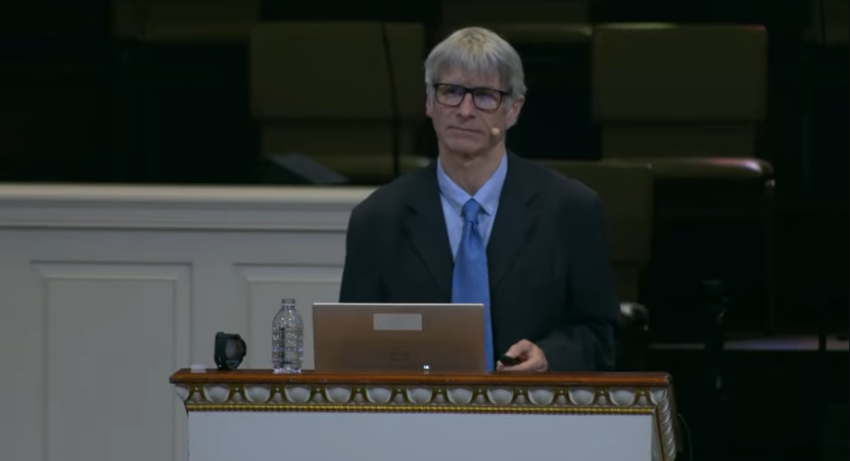
Pointing to the precision of human biology, Burgess added, “I think anyone who works in biomechanics is in awe of the human body. Innovation beyond spacecraft engineering. Precision beyond spacecraft engineering down to the molecular level. Coordination beyond spacecraft engineering. Trillions of parts, not hundreds of thousands of parts.”
A highly decorated mechanical engineer, Burgess was introduced as the top mechanical engineer in Great Britain in 2019 among 120,000 professionals. His credentials include designing spacecraft components for the European Space Agency, working on the Hubble Space Telescope, and leading the design of the chain sprocket transmission for Great Britain's Olympic cycling team.
His latest book, Ultimate Engineering: An Engineer Investigates the Biomechanics of the Human Body, draws on his decades of research in engineering design and biology, including his work on the Envisat satellite, the world's largest Earth-observation satellite at the time.
That endeavor, said Burgess, required groundbreaking innovation in gearboxes for solar array deployment, extreme precision, and coordination of tens of thousands of parts. He recounted a particular tense moment when the project manager warned him that a failure in his solar array could doom the $2 billion mission within 50 minutes of launch.
“I said, ‘I did not know that,” he shared. “And he said, ‘If you could think about that for the rest of the project, I would really appreciate that.’”
Yet, Burgess asserted, biology surpasses even the most advanced spacecraft engineering, and his work proposes a new grading category for biological systems: "ultimate engineering,” design at the physical limit of chemistry and physics, with molecular-level resolution and fine-tuning.
"I cannot give an A-plus to God’s design,” he said. “All I can say is it is ultimate."
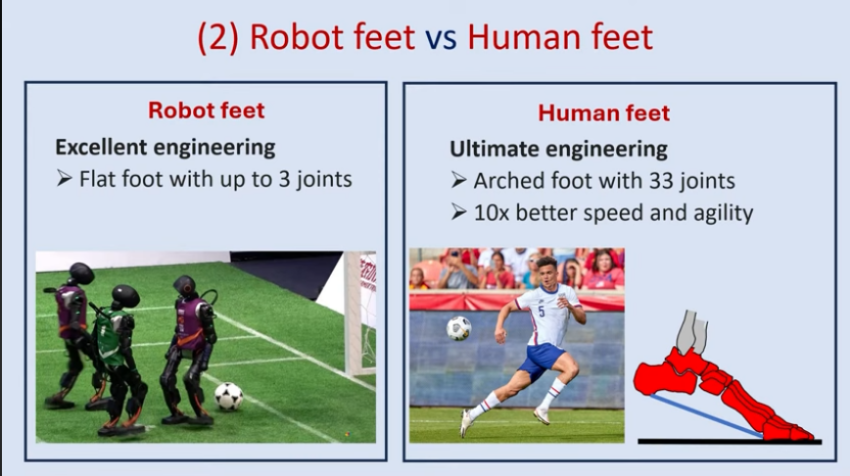
Sharing multiple examples, Burgess highlighted specific comparisons between human engineering and “ultimate engineering,” most strikingly with human feet, which feature 10 times more joints and functionality than robot feet he has built.
Such precision engineering, he said, enables human feats like sprinting at 20 mph while tracking and intercepting a ball — a task beyond the capabilities of current humanoid robots.
“Humanoid robots cannot do what humans can do. And here is the expert scientific judgment. The structures in the ankle work in perfect synchronization,” he said. “Notice that word ‘perfect.’ I am not the only one who can recognize ultimate engineering in the human body. So this is true science.”
In contrast, said Burgess, critics like biologist Jerry Coyne who espouse an evolutionary worldview claim that "imperfect design is precisely what we expect from evolution." Burgess argued evolutionary theory anticipates "just good enough engineering or poor engineering," while the evidence shows perfection supporting Intelligent Design, even in the face of disease or genetic disorders.
“You must not mix up health issues with design,” he said. “They are two different things." He likened diseases to external attacks like flooding a car or assembly errors, not inherent poor design.
And it’s not just functionality, said Burgess, that points to an ultimate Engineer, but the elegance and beauty of the Creation.
“God has padded us on our rear, and he has given us padding just where we need it. Our muscles also heat up blood, but also muscles give you a beautiful figure in your body,” he said. “So God uses muscles to give us beauty, function and protection. And it is that elegance and multi-functioning which really causes me to be in awe of the Creator.”
News Source : https://www.christianpost.com/news/british-engineer-human-hand-pinnacle-of-mechanical-engineering.html