Imagine 3,000 people, strangers from across the known world, who heard a single message and were so transformed that they immediately began living life together. No apps. No algorithms. No follower counts. Just radical, authentic community.
That's the scene described in Acts 2, one of the most extraordinary moments in human history. And while two millennia have passed, the principles that shaped the early church are not just timeless, they're urgently needed today, when loneliness is at epidemic levels and social media often leaves people feeling more disconnected than ever.
In this deep dive, we'll walk through five core principles from Acts 2, examining what they meant in the first century and what they look like when applied to Christian community today.
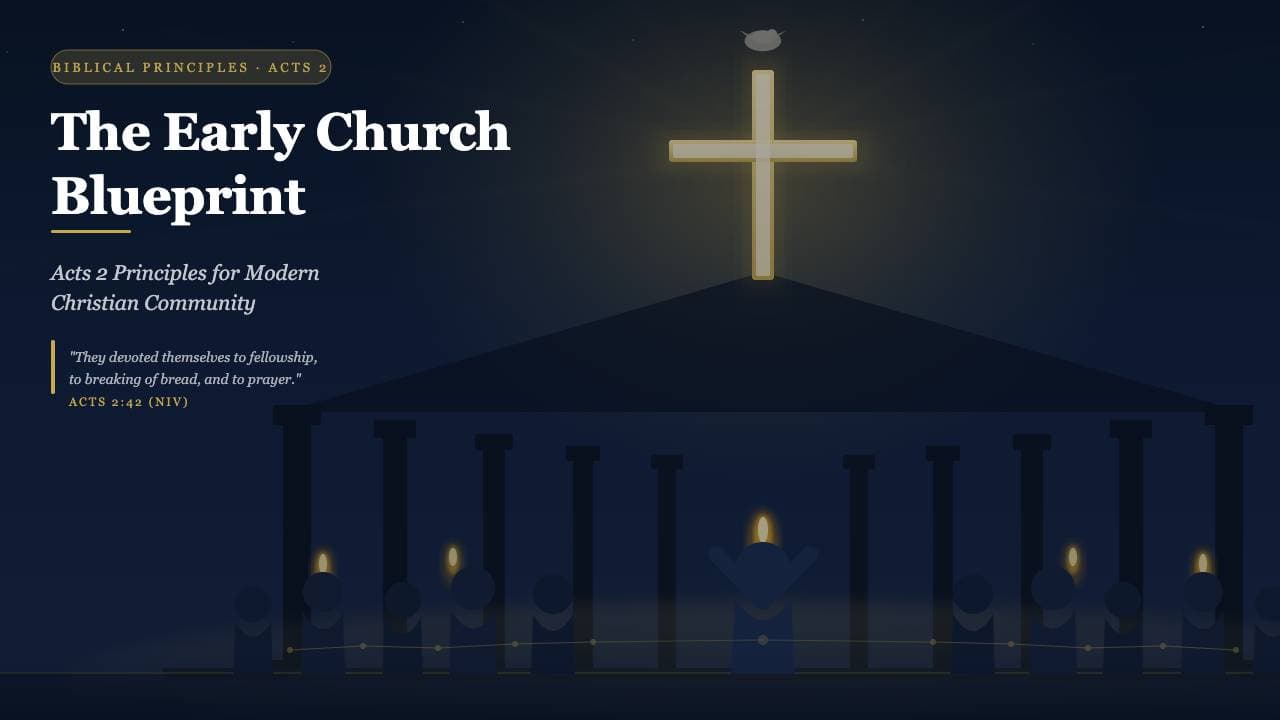
"They devoted themselves to the apostles' teaching and to fellowship, to the breaking of bread and to prayer. Everyone was filled with awe at the many wonders and signs performed by the apostles. All the believers were together and had everything in common."
, Acts 2:42–44 (NIV)
The Context: What Happened in Acts 2?
The chapter opens with the dramatic arrival of the Holy Spirit on the day of Pentecost, tongues of fire, a rushing wind, and disciples suddenly speaking in languages they didn't know. Peter stands up and delivers a sermon that cuts to the heart of thousands of listeners. The result is staggering:
- 3,000 people are baptized in a single day
- The first true Christian community is born on the spot
- Believers begin sharing meals, pooling resources, and meeting daily
- Signs and wonders multiply as the community grows
- People are added to their number every single day
This was not a Sunday service model. This was life-on-life, every-day-together, deeply committed community. What drove it? Five pillars.
The Five Pillars of Acts 2 Community
Acts 2:42 gives us a compact blueprint. Four practices are named explicitly, and a fifth emerges from the surrounding verses. Together they form a complete framework for authentic Christian community.
- 01, The Apostles' Teaching (Acts 2:42a): Grounding the community in shared truth. Not opinion, not preference, but the teaching of those who walked with Jesus.
- 02, Fellowship / Koinonia (Acts 2:42b): Deep, mutual participation, not just attendance. The Greek word koinonia implies partnership, shared stake, and belonging.
- 03, Breaking of Bread (Acts 2:42c): Shared meals that embodied the Lord's Supper. In the Roman world, table fellowship was profound, you ate with people you trusted.
- 04, Prayer (Acts 2:42d): Not private, individual prayer alone, communal prayer that kept the whole community aligned with God's presence and power.
- 05, Radical Generosity & Shared Life (Acts 2:44–45): Believers selling possessions to meet needs. When the first four pillars are practiced deeply, generosity flows naturally. This is what made the early church visible to a watching world.
Pillar 1: Devoted to Teaching, Truth as Community Glue
The early community didn't begin with programs or events. It began with sitting under teaching, the apostles' account of who Jesus was, what He said, and what His death and resurrection meant.
Truth was not just intellectual content. It was the shared foundation that gave the community a common language, a common story, and a common identity. Without it, community becomes merely social, nice, but shallow.
"When a community shares a common story, they don't just tolerate each other, they need each other."
For Modern Community: Digital faith communities thrive when anchored in shared Biblical content, not just inspiration or motivation, but actual teaching that shapes how members think, pray, and live. Every post can be a moment of mutual teaching.
Pillar 2: Koinonia, The Fellowship the World Can't Manufacture
The Greek word koinonia is often translated "fellowship," but it means much more than coffee after church. It denotes a shared participation, a mutual investment in each other's lives, burdens, and victories. In the early church, koinonia looked like:
- Meeting daily in the temple courts and in homes
- Knowing one another deeply across social divides (Jew and Gentile, slave and free)
- Sharing in both celebration and suffering
- Being genuinely known, not performing spirituality
"They broke bread in their homes and ate together with glad and sincere hearts, praising God and enjoying the favor of all the people."
, Acts 2:46–47 (NIV)
For Modern Community: True koinonia is possible in digital spaces, but only with intentional design. Platforms that promote meaningful engagement move people closer to genuine participation than passive scrolling ever could. The goal is not reach. It's depth.
Pillar 3: Breaking Bread, The Sacredness of Presence
In first-century culture, who you ate with said everything about your community. Sharing a meal was a profound act of trust, equality, and commitment. The early church ate together, in homes, with joy, around the Lord's Supper.
This wasn't logistical. It was theological. The meal said: You belong here. You are known. You are welcome.
For Modern Community: Technology should be the bridge to presence, not the substitute for it. The best faith apps don't replace the table, they help people find their way to one.
Pillar 4: Prayer, The Source Code of Community
The early church prayed together, not just individually. Prayer meetings drew hundreds. Prayer preceded every major decision, mission, and breakthrough.
Communal prayer does something unique: it orients an entire community toward God rather than toward itself. Without it, even the most well-intentioned faith community drifts into self-reliance.
For Modern Community: Shared prayer requests, community intercession boards, and prayer-partner matching are powerful features of a modern faith platform. When believers can see that others are praying for them, in real time, across geographies, it replicates the communal prayer dynamic of Acts 2.
Pillar 5: Radical Generosity, When Community Becomes Witness
Acts 2:44–45 describes believers selling property and giving to anyone who had a need. This was not communism, it was love made visible. And it was noticed by everyone around them.
The fifth pillar is the most outward-facing. It's what makes a community a witness rather than just a gathering. When believers care for each other extravagantly, financially, emotionally, practically, the surrounding world takes notice.
"And the Lord added to their number daily those who were being saved.", Acts 2:47. The community's growth was not the result of marketing. It was the result of a life together so compelling that people couldn't help but want in.
Then & Now: The Blueprint in Modern Context
Here's how each Acts 2 principle maps directly to modern Christian community:
| Principle | First Century | Today |
|---|---|---|
| Teaching | Apostles' eyewitness testimony, oral teaching in synagogues and homes | Daily Scripture engagement, Bible-based content, online sermon series, Christian apps |
| Koinonia | Daily meetings in homes and temple courts across social barriers | Small groups, faith-based social platforms, cross-cultural Christian community online |
| Breaking Bread | Shared meals in homes; Lord's Supper as regular practice | Church dinners, home groups, meetups organized via digital community |
| Prayer | Community prayer gatherings, corporate intercession before decisions | Shared prayer requests, prayer chains, community intercession on faith platforms |
| Generosity | Selling possessions; giving to any in need within the community | Church benevolence funds, Christian crowdfunding, community giving through digital networks |
What the Early Church Tells Us About Community Today
The early church didn't have a building, a denomination, a podcast, or a ministry budget. What they had was far more powerful:
- A shared story rooted in the resurrection of Jesus
- A deep commitment to one another across every difference
- A rhythm of gathering, eating, praying, and giving
- A generosity that made their community visible and compelling
- A supernatural presence they believed was among them when they gathered
"The world doesn't need another social network. It needs a community. Acts 2 shows us what that looks like."
Whether you're a pastor building a small group ministry, a Christian looking for genuine connection online, or a faith leader asking how to use digital tools well, the Acts 2 blueprint is your north star. Not because it's ancient, but because it works.
The early church added members daily not because of programming or promotion, but because their life together was simply too good to ignore. That's the invitation before every Christian community today.
Join ActsSocial, a faith-based social network designed around the principles of the early church. Fellowship, prayer, encouragement, and shared purpose. Not likes. Acts. Join free at actssocial.com
Related Articles
1. Best Christian Podcasts for 2026
2. Best Christian Social Media Apps in 2026
3. The Power of Prayer for Life, Health, and Family
4. How My Life Changed After ActsSocial
5. 50 Bible Verses on Forgiveness, Grace and Mercy
If you lead a church or ministry, see how ActsSocial helps churches build real community online. Want to gather people around faith? ActsSocial helps community groups stay connected through the week.
Frequently asked questions
What are the main principles of Acts 2 community?
Acts 2:42–47 outlines five core principles: (1) Devotion to apostolic teaching, grounding the community in shared Biblical truth; (2) Koinonia, deep, mutual fellowship that goes beyond socializing; (3) Breaking of bread, shared meals and the Lord's Supper; (4) Communal prayer, interceding together rather than in isolation; and (5) Radical generosity, sharing resources to meet one another's needs. Together these five pillars created a community so compelling that people were added to it daily.
How can I apply Acts 2 principles in a modern church?
Start with intentional small groups that go beyond Sunday attendance, groups that eat together, study Scripture together, and pray for one another by name. Use digital tools to stay connected between meetings, share prayer requests, and coordinate acts of generosity. Acts 2 community can happen in a home, a church building, or through a well-designed faith-based platform like ActsSocial.
Is Christian community possible online?
Yes, with the right design and intentionality. Faith-based social networks like ActsSocial are designed to support Acts 2-style community: shared Biblical content, prayer requests, encouragement, and community engagement that goes beyond vanity metrics. Online community should complement in-person fellowship, not replace it.
What is koinonia and why does it matter?
Koinonia (Greek: κοινωνία) is the New Testament word usually translated "fellowship," but it carries a deeper meaning, shared participation, mutual investment, and partnership. It implies that community members have a genuine stake in one another's lives. Koinonia matters because it produces accountability, growth, generosity, and resilience in a faith community.
Why did the early church grow so rapidly?
Acts 2:47 says the Lord "added to their number daily." The growth came from the power of the Holy Spirit, the compelling nature of their community life, the boldness of their testimony, and acts of generosity unprecedented in the Roman world. The early church did not have a marketing strategy, their life together was the message.
What is ActsSocial and how does it connect to Acts 2?
ActsSocial is a faith-based social media platform inspired by the principles of Acts, specifically the early church's commitment to community, generosity, and encouragement. The platform replaces "likes" with "Acts" to promote intentional, faith-driven engagement, designed for Christians to connect meaningfully, share Scripture, support one another in prayer, and build Acts 2-style community in the digital age.

Christian Social Network for Churches and Individuals
Christian Social Network for Churches and Individuals, How ActsSocial Bridges the Gap There has always been a gap between the church as an institution and the believer as an ind…