 Your post is being uploaded. Please don't close or refresh the page.


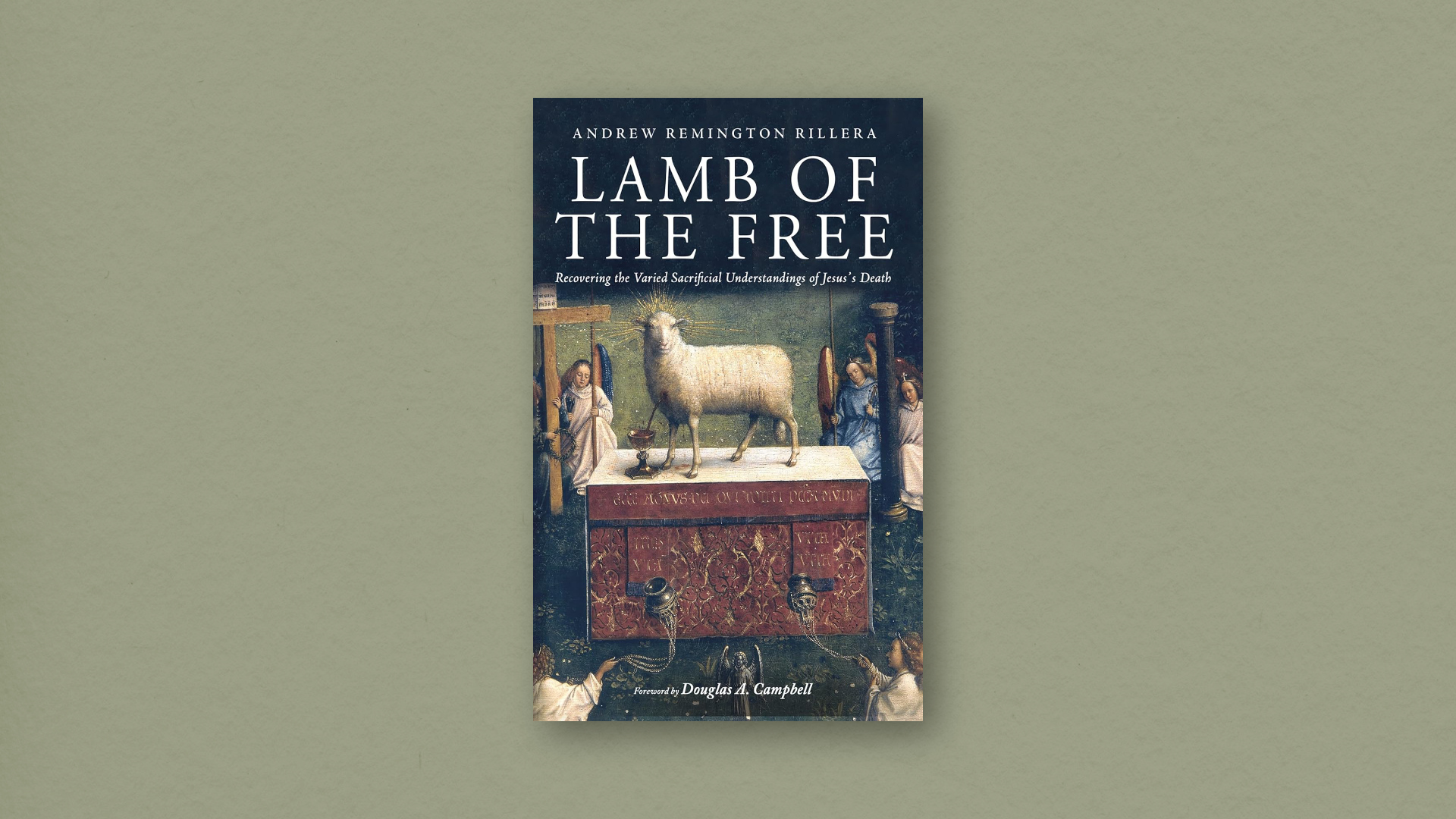
When it comes to understanding our redemption, many evangelicals emphasize the doctrine of penal substitutionary atonement (PSA). Most see repeated evidence in Scripture that Jesus takes the penalty (P) sinners deserve, as their substitute (S), to atone (A) for them. This rises not just from explicit New Testament evidence but also from the way Old Testament sacrifice foreshadows Jesus’s death: An animal takes the penalty (P) sinners deserve, as their substitute (S), to atone (A) for them.
Andrew Remington Rillera, assistant professor of biblical studies and theology at The King’s University in Edmonton, Alberta, strongly disagrees with this understanding. In Lamb of the Free: Recovering the Varied Sacrificial Understandings of Jesus’s Death, he argues that PSA is a thoroughly unbiblical idea.
His own approach to atonement is closest to the recapitulation understanding of Christ’s work that Irenaeus outlined, though many believe this view is compatible with PSA (see works by McNall and McKnight). Rillera doesn’t. He argues that PSA is a foreign concept to the Old Testament’s sacrificial system (chap. 1–4) and that even the New Testament doesn’t support PSA (chap. 5–8).
Though I find Rillera’s overall argument against PSA unpersuasive, I want to begin by noting the area I found most exemplary: the emphasis on our union with Christ in his death and resurrection. That union’s rich blessings should be regularly highlighted, and I’m grateful the book has done so. For me, it made union with Christ even more beautiful.
As for the book’s main thesis, I’ll consider three of its major claims against PSA.
Claim #1: Sacrifice Isn’t About Death
Rillera’s argument begins by asserting that “there is no such thing as a ‘substitutionary death’ sacrifice in the Torah” (10).
This assertion relies on the idea that Old Testament sacrifice is about presenting the animal’s life, not bringing about its death, and that Leviticus therefore “conceptualize[s] the death of the sacrificial animal as ‘not-a-killing’” (17, emphasis original). If this is true, then Old Testament sacrifice isn’t about the animal dying in the offerer’s place, and the ritual doesn’t foreshadow Jesus’s death on the cross.
To show that Old Testament sacrifice isn’t about death, Rillera argues in part that “the death of the animal—the slaughter itself—is given no ritual or theological meaning by any biblical text” (20). In support, he notes ways that sacrificial texts seem not to emphasize the animal’s slaughter but rather emphasize acts associated with the altar and performed by the priest, like burning the meat and presenting the blood. To him, this suggests the slaughter itself is insignificant.
But even a quick read of the key sacrificial texts in Leviticus 1–7 shows an interesting pattern: They regularly specify that the animal’s slaughter must take place “before the LORD” or “in front of the tent” where he dwells (1:5, 11; 3:8, 13; 4:4, 15, 24; 6:25). Leviticus 17:3–4 expands on this, emphasizing that the animal must be slaughtered before the Lord to count as being presented to him.
In short, if it’s not slaughtered before the Lord, it’s not slaughtered to the Lord. There’s no option for slaughtering the animal at one place and offering it at another. Slaughtering and offering go hand in hand. And that means that “the death of the animal—the slaughter itself”—isn’t insignificant but central to offering the animal.
Claim #2: Sacrificial Atonement Only Relates to Cleansing
Scholars agree that one of the only verses explaining how sacrificial atonement works is Leviticus 17:11: “The life of the body is in the blood, and I myself have given it to you on the altar to make atonement [kipper] for your lives, for it is the blood that makes atonement [kipper] by means of the life” (my translation).
But, as Rillera notes, scholars debate whether the Hebrew word kipper—typically translated “to make atonement”—refers here to ransom or cleansing or some combination of the two (122). For Rillera, the better meaning is cleanse (or in his language, “decontaminate”), whereas some combination of the two appears to me to account best for the data.
Ransom
We begin with ransom, which in the Bible refers to a payment delivering guilty people from a penalty—often death—that they would otherwise have to pay (Ex. 21:30; 30:12). Scholars from a wide array of backgrounds understand kipper in Leviticus 17:11 to refer to ransom (see Levine, 115; Milgrom, 707–8; Moffitt, 263–64). This is because the exact phrase “to [kipper] for your lives” found in 17:11 occurs in only two other places, both of which use kipper to refer to “ransom” (Ex. 30:15; Num. 31:50).
In response, Rillera argues that Exodus 30:15 and Numbers 31:50 occur in contexts about money, but Leviticus 17:11 doesn’t. The implication: If the monetary concept is absent, ransom cannot be in view.
What this misses is that in the biblical world, a ransom isn’t limited to money. A ransom can be the giving of one living being in place of another, such as one people group being given as a “ransom . . . in exchange for [the] life” of another people group (Isa. 43:3–4). So the question isn’t “Is this a monetary context?” but “Is this a ransom context?”
For the sins and major impurities requiring sacrificial atonement, the answer is “Yes, this is a ransom context.” That’s because sins and major impurities share an important similarity: Both endanger.
Sin obviously endangers because sinners are liable to God’s punishment and need ransom. But major impurities (like that coming from leprosy) also endanger and require ransom since they pollute not only people but also holy items (Lev. 16:16). This pollution results in death if not properly addressed (15:31). In either case—sin or impurity—the offerer is endangered, meaning we have a context requiring ransom.
Kipper in 17:11 is therefore well understood as relating to ransom. Instead of the offerer’s lifeblood, the animal’s lifeblood is given in death as the ransom payment. And this means all the elements of PSA are in place: The animal experiences the death the offerer deserves (the penalty) in the offerer’s place (as a substitute), to reconcile the offerer to God (for atonement).
Cleansing
What about the cleansing aspect? This is where a second similarity exists between the sins and major impurities requiring sacrifice: Both defile.
Major impurities obviously defile since the offerer needs cleansing, but sins also defile the sinner and need cleansing: “For on this day shall atonement be made for you to cleanse you. You shall be clean before the LORD from all your sins” (16:30).
Instead of the offerer’s lifeblood, the animal’s lifeblood is given in death as the ransom payment.
In short, sins and major impurities both endanger (requiring ransom) and pollute (requiring cleansing).
It’s a two-pronged problem requiring a two-pronged solution: ransom and cleansing. Sacrifice can achieve both because the blood is a dual-function agent: It’s both the ultimate ransoming agent (17:11) and the ultimate cleansing agent (see 8:15).
When sin is the focus, the ransoming function comes to the fore, and the offerer is “forgiven” (4:20, 26, 31). When impurity is the focus, the cleansing function comes to the fore, and the offerer is made “clean” (12:7; 14:20). But both ransom and cleansing are happening in each context because both are needed and the blood accomplishes both.
In the context of atoning sacrifices, kipper refers to a “purifying ransom” and a “ransoming purification.” And because of this ransoming element, PSA is at the heart of sacrificial atonement.
Claim #3: If Jesus’s Death Is Participatory, It Can’t Be Substitutionary
Rillera argues that New Testament authors understand Jesus’s death as a “participatory phenomenon” that believers “are called to share in experientially,” as shown by verses speaking of us “picking up our cross” and following Jesus (Mark 8:34) or speaking of our union with Christ in his death by faith (Rom. 6:3–8) (7).
Rillera then argues that ff this is true, then Jesus’s death cannot be a substitutionary phenomenon since (according to Rillera) participation and substitution exclude one another by definition.
Even if we grant that the ideas of participation and substitution exclude one another (which I doubt), the book’s approach rests on a problematic assumption: When describing spiritual realities, the Bible can’t use different ideas or images that exclude one another.
This assumption doesn’t hold. For example, when describing a believer’s salvation, Paul sometimes uses adoption imagery (Gal. 4:5) and other times resurrection imagery (Col. 2:13). These images exclude one another by definition: One centers on a living person being adopted, the other on a corpse being made alive.
Why does Paul do this? Because there is a richness to salvation that is best communicated by using multiple images, even if they’re in logical tension with one another. And if Paul is happy to do this when describing salvation, he can surely do likewise when describing the events bringing salvation to pass.
This argument has important implications for a text like Romans 5:7–8, where Paul argues, “7 For one will scarcely die for a righteous person—though perhaps for a good person one would dare even to die—8 but God shows his love for us in that while we were still sinners, Christ died for us.”
Rillera grants that verse 7 is speaking of substitutionary death, but argues that verse 8 can’t be doing the same. Why? Because Paul uses participatory language to describe Jesus’s death in Romans 6, and Rillera assumes Paul cannot speak of Jesus’s death as both substitutionary and participatory since these images exclude one another.
But as seen above, this assumption doesn’t hold, and the simplest explanation remains the most likely: Verses 7 and 8 are both speaking of substitutionary death.
7 For one will scarcely die for [= in place of] a righteous person—
though perhaps for [= in place of] a good person one would dare even to die—
8 but God shows his love for us in that while we were still sinners, Christ died for [= in place of] us.
Paul is clear: Jesus dies as a substitute for sinners. He is equally clear that Christ’s death reconciles sinners to God (v. 10), meaning this is substitutionary atonement. And since Paul emphasizes in Romans that sin results in death (Rom. 1:32; 5:12–21; 6:23; 7:5, 11), the implication is straightforward: By suffering death in place of sinners, Jesus is suffering their penalty.
In Romans 5:7–8, we have PSA in its fullness: Jesus taking the penalty sinners deserve as their substitute, in this way reconciling them to God.
First Importance
In an extended review, I interact with most of the book’s other arguments and discuss various motivations Rillera identifies that led him to write a book against PSA.
Paul is clear: Jesus dies as a substitute for sinners.
But in this short review, I hope to have shown that the biblical text doesn’t support three of the book’s major claims and that the relevant biblical passages affirm that PSA is central to the Bible’s description of Old Testament sacrifice and of Jesus’s death on our behalf. Contrary to what Lamb of the Free argues, penal substitutionary atonement is a very biblical idea.
Why does this matter? In summarizing the gospel, Paul begins, “What I received I passed on to you as of first importance: that Christ died for our sins according to the Scriptures” (1 Cor. 15:3, NIV). If Christ’s death for our sins is where the gospel begins, getting it right matters deeply indeed.
News Source : https://www.thegospelcoalition.org/reviews/lamb-free-atonement-biblical/