 Your post is being uploaded. Please don't close or refresh the page.


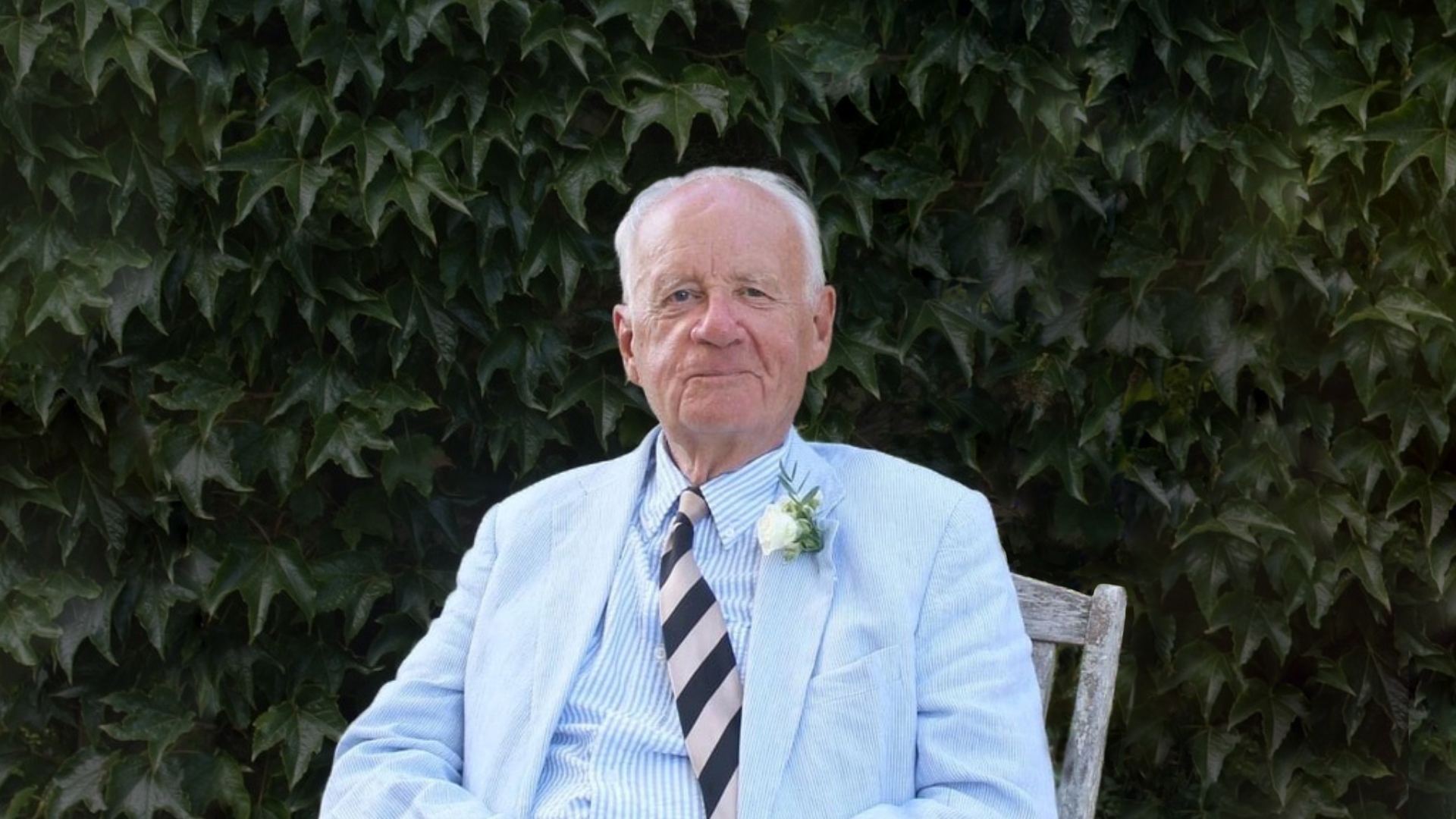
Paul Helm, who died on December 29 at home in Gloucestershire aged 85, was the leading philosophical defender of Calvinism in the United Kingdom over the past 50 years. Helm was the best kind of Calvinist: His steely intellect was concealed by a genial manner, and he enjoyed company over a pint in the pub as much as he did reading weighty Puritan works.
Helm was born in Blackpool in 1940, where his parents attended the Baptist Tabernacle. He remained of a conservative Calvinistic outlook for the rest of his life; he once joked that the volume How Helm Has Changed His Mind would be a slim one. The Tabernacle in Blackpool was significant for another reason: At its services, Helm got to know Judith—they were married in 1962.
After studying philosophy, politics, and economics at Worcester College, Oxford, Helm was offered a job at the University of Liverpool; he remained in the Department of Philosophy for nearly 30 years until 1993. While at Liverpool, he had Christian fellowship at various Baptist chapels, though he never formally became a member of any, since he protested against a membership policy that would have excluded his hero, paedobaptist philosopher-theologian Jonathan Edwards.
In 1989, tragedy struck: Judith died of cancer, leaving Helm to finish bringing up their four children (Anna, John, Philip, and Ben), the youngest of whom was still at home.
Academic Vocation
While he was at Liverpool, Helm published several books, including his Calvin and the Calvinists, which argued that Calvin’s theological successors did not, as had been alleged, significantly harden Calvin’s position on matters such as election. He published his most important philosophical book, Eternal God: A Study of God Without Time, in which he argued for the then-unfashionable view that God was timelessly eternal rather than everlasting in time. This was later republished in a second edition and remains an essential item on scholarly reading lists.
He also wrote an underrated trilogy on the experience of the Christian life (The Beginnings, The Callings, and The Last Things), published by the Banner of Truth Trust, for whose magazine Helm also penned many articles.
Helm was the best kind of Calvinist: His steely intellect was concealed by a genial manner, and he enjoyed company over a pint in the pub as much as he did reading weighty Puritan works.
In 1993, Helm, a reader in philosophy at Liverpool, was offered the position of professor of the history and philosophy of the Christian religion at King’s College, London. This prestigious post was one of three named chairs in the philosophy of religion in England (the others being at Oxford and Cambridge). While he was there, he published with InterVarsity Press The Providence of God, a defense of the Augustinian/Calvinist view that God ordains everything that comes to pass. He also published three philosophical works relating to faith and belief.
In 1994, he married Angela, whom he met at King’s, and they were later blessed with a daughter, Alice. In London, he also became a member of the Evangelical Library and Dr Williams’s Library, subsequently becoming involved in the governance of both. He was selected by the BBC to take part in a reboot of flagship intellectual program The Brains Trust, memorably engaging in spirited discussion with well-known atheist Richard Dawkins.
In 2000, Helm took early retirement from King’s, but the next year he, Angela, and Alice moved to Vancouver, Canada, where he became the inaugural J. I. Packer professor of philosophical theology, a chair whose title was dear to Helm because of his admiration for Packer (despite a few theological differences). In these years, his attention turned more to the thought of John Calvin, with the first of three volumes being focused on Calvin’s philosophy, a groundbreaking addition to the voluminous literature on the great reformer.
Helm retired again in 2005, but was lured back out of retirement for a second time, on this occasion by the Highland Theological College in Scotland, where he taught theology for three years. Even when fully retired, he still kept up his “Calvinistic work ethic” and produced two monographs on human nature and free will, insisting the free will enjoyed by human beings mustn’t be thought of as something independent of God’s will.
Legacy
In total, Helm’s output was prodigious: He wrote 16 books and edited a further 9. He also wrote at least 97 journal articles and some 80 book chapters for edited collections.
On top of this, he produced many articles for magazines and Christian newspapers such as The Banner of Truth, Reformation Today, Evangelical Times, Evangelicals Now, Modern Reformation, and others, and hundreds of book reviews. He was much in demand as a lecturer in the United States for The Southern Baptist Theological Seminary, Reformation Bible College, Reformed Theological Seminary, and other institutions.
Academically, Helm was at ease in three spheres: He was by instinct and mental constitution a philosopher, and his logical acumen and ability to make sharp distinctions were well respected on the seminar floor, but he also wrote much on various aspects of systematic theology, particularly the doctrine of providence, and on historical theology, especially Calvin and the Reformed scholastics. He was an inspiration to his doctoral students, who found in him a personal example as well as a source of academic knowledge and wisdom.
He was a man of solid and unswerving Christian faith, who held firmly to the doctrines of grace even when faced with personal tragedy.
Helm never let the honors he received go to his head. He was just as likely to be found feeding the tortoises, gardening, or taking on all comers in table tennis as he was to be leafing through academic tomes. He was always modest about his accomplishments and wrote many commendations for others’ books.
Above all, Helm was a man of solid and unswerving Christian faith, who held firmly to the doctrines of grace as he found them in the Christian Scriptures even when faced with personal tragedy. Among the many tributes that have poured forth since he died, it’s noteworthy that many outside the Christian faith, as well as his fellow believers, have appreciated his great integrity, kindness, and good humor.
Helm is survived by Angela, his five children, eight grandchildren, two great-grandchildren, and his brother Philip.
News Source : https://www.thegospelcoalition.org/article/paul-helm-1940-2025/