 Your post is being uploaded. Please don't close or refresh the page.


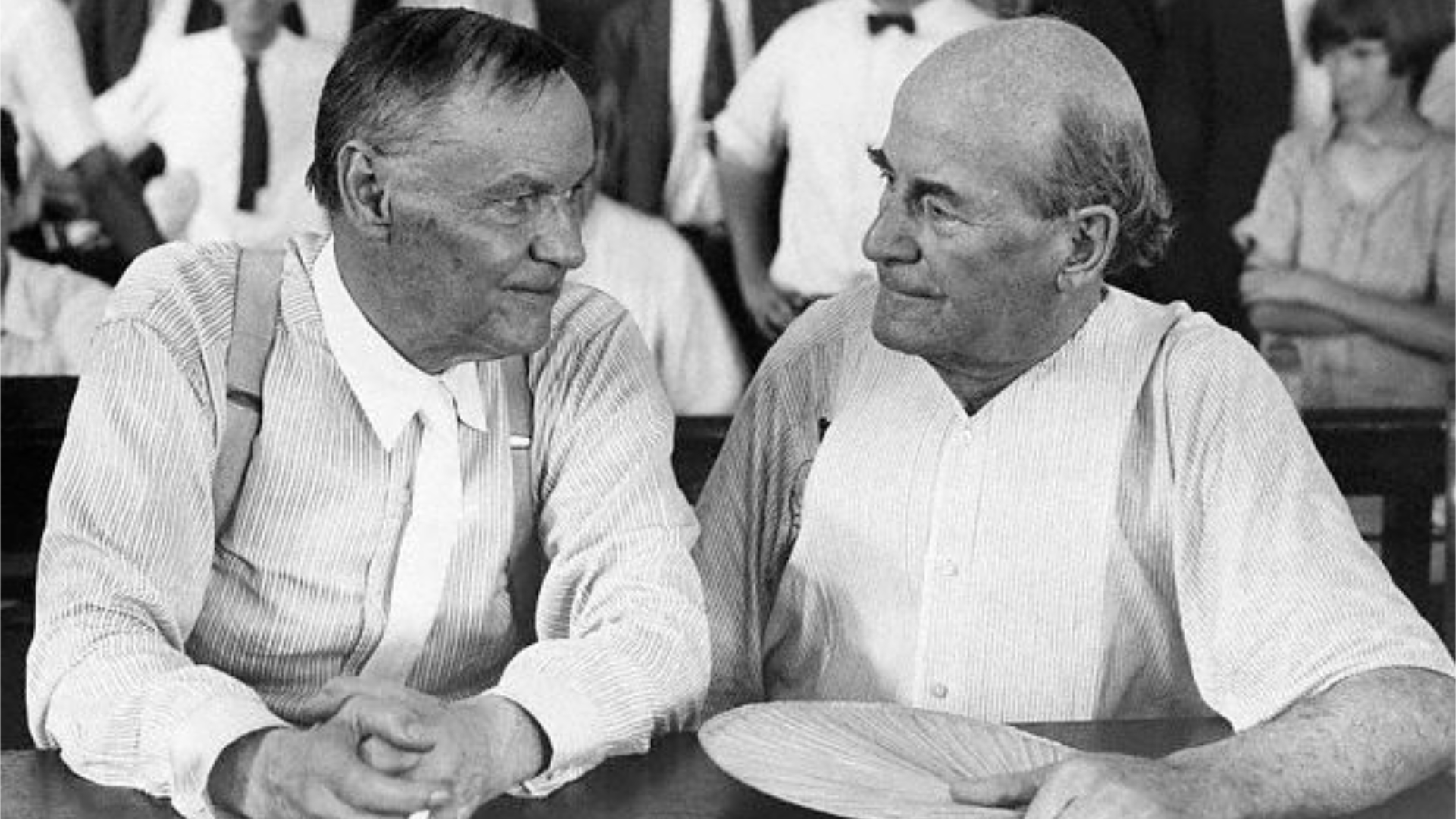
This year marks the centennial of the Scopes Trial of 1925, one of the most famous moments in what has come to be called the Fundamentalist-Modernist Controversy. The controversy was actually a series of debates between theological conservatives (“fundamentalists”) and liberals (“modernists”) in several Protestant denominations in the years between the two world wars.
The trial remains embedded in the American imagination a century later. It was a key skirmish in what’s often depicted as the great ideological conflict of the modern world: science versus religion. However, this telling is too simplistic.
We don’t always remember the difference between historical fact and fiction. Sarah Irving-Stonebraker argues that Christian historians are called to be “priests of history” who steward the past in our ahistoric age. The Scopes Trial is a good example of how our imaginations sometimes play tricks on us when it comes to the past. Its hundredth anniversary is an opportunity to set the record straight.
Heavyweight Lawyers
In the 1920s, several states passed laws to outlaw the teaching of Darwinian evolution in public schools. In 1925, Tennessee passed an anti-evolution law called the Butler Act. John Scopes, a high school football coach and substitute biology teacher in Dayton, Tennessee, was charged with breaking that law.
The ensuing trial took on a life of its own, shaping the way the American public thinks about the relationship between faith and culture.
One reason the trial became big news was the key personalities involved. William Jennings Bryan, one of the most revered orators and politicians of the era, represented the state of Tennessee. Bryan, nicknamed the “Great Commoner,” was a three-time Democratic candidate for president and served as secretary of state under Woodrow Wilson. Bryan resigned from the Wilson administration in 1915 in response to Wilson’s diplomacy toward Germany, which Bryan correctly feared would lead America into World War I.
Scopes was represented by Clarence Darrow, one of the greatest lawyers of his day. Darrow had become a household name in 1924 for his part in what many at the time called the “trial of the century.” Two wealthy Chicago teenagers, Nathan Leopold and Richard Loeb, confessed to murdering a third teenager, Bobby Franks. Leopold and Loeb were influenced by Friedrich Nietzsche and wanted to commit the perfect crime, thus demonstrating they were Übermenschen (superior men). Though they were guilty of the crime, Darrow successfully defended an insanity plea on Leopold’s and Loeb’s behalf, which resulted in them being spared the death penalty.
How the Trial Evolved
Though The State of Tennessee v. John Thomas Scopes was ostensibly about whether or not Scopes violated the Butler Act, the wider creation-evolution debate soon became the central issue of concern. The skeptical journalist H. L. Mencken relentlessly lampooned fundamentalism and especially creationism.
Mencken was especially hard on Bryan, whom he thought was a self-aggrandizing fundamentalist bumpkin. In the trial’s climactic moment, Bryan himself took the stand and was cross-examined by Darrow. The erudite agnostic Darrow humiliated Bryan, who had trouble answering the most common objections to creationism.
We sometimes forget that the Scopes Trial ended in a legal victory for the plaintiffs. Scopes was convicted and fined, and he soon stopped teaching in Dayton. But the trial was also a public relations disaster for fundamentalism and contributed to the widespread acceptance of evolution in the ensuing years. Distraught by his encounter with Darrow, Bryan died ignominiously five days after the trial concluded. Bryan is better known today for his embarrassing performance in Dayton than for his long career of public service.
We sometimes forget that the Scopes Trial ended in a legal victory for the plaintiffs.
Popular memory about the Scopes Trial contains a lot of truth. Yet it also tends to frame the case as simply a matter of religious dogma versus open-minded scientific inquiry. However, historians know the actual events in Dayton were more complicated than they have often been portrayed.
Staged Controversy
The American Civil Liberties Union (ACLU), founded in 1920 to defend the Bill of Rights, announced it would finance a test case if a pro-evolution teacher in Tennessee was willing to come forward. For the ACLU, this was a matter of free speech. Civic leaders in Dayton saw an opportunity to attract attention to their city by hosting the trial.
Both Dayton and fundamentalists got what they wanted out of the trial. The Scopes Trial put the city on the map. Star witnesses, noted journalists, and interested spectators from across the country descended on Dayton, boosting the local economy. Fundamentalists were pleased with the trial’s outcome, and historian Madison Trammel has demonstrated that fundamentalists remained engaged in anti-evolution activism well into the 1930s.
After the Fundamentalist-Modernist Controversy subsided in the late 1930s, the creationists controlled most of the major Protestant denominations and the Federal Council of Churches. Postwar historians sympathetic to modernism later interpreted the Scopes Trial as a key moment in the decline of fundamentalist influence in American culture.
The results were less positive for the ACLU, and especially for Scopes himself. While the ACLU got the test case it sought, it lost the trial. Across the South and Midwest, it remained illegal to teach Darwinism in public schools for decades. In Tennessee, the Butler Act remained on the books until 1967.
Scopes was fined $100 and lost his job. He left Dayton to continue his graduate studies in geology at the University of Chicago, though he never escaped the shadow of the trial and remained bitter about it for the rest of his life. Scopes also long claimed that the students who testified against him in court never heard him discuss evolution in class.
Theatrical Reimagination
What most Americans know about the Scopes Trial comes not from history courses but from two influential works of fiction. In 1955, the events were dramatized in a play titled Inherit the Wind. In 1960, a theatrical version of Inherit the Wind was released, starring Spencer Tracy in the role of Henry Drummond, a fictional stand-in for Darrow.
Scopes also long claimed that the students who testified against him in court never heard him discuss evolution in class.
The backdrop for these fictional versions of the trial isn’t really the evolution debate but McCarthyism. In the early 1950s, controversial Wisconsin Senator Joseph McCarthy became the public face of conservative efforts to curtail communism’s spread in American culture. McCarthy believed Hollywood and the Department of State were both riddled with communists, and his career ended in disgrace when his claims were proven exaggerated.
McCarthyism became a watchword for reactionary, conspiratorial conservatism. In Inherit the Wind, creationists were proxies for McCarthy and his allies: culturally backward, superstitious, and anti-intellectual. Matthew Harrison Brady, the fictional stand-in for Bryan, was portrayed as a particularly pathetic foil to the sympathetic Drummond.
Inherit the Wind has been performed as a stage play countless times over the past 70 years, and the film has been remade three times, as recently as 1999. In his Pulitzer Prize–winning book Summer for the Gods: The Scopes Trial and America’s Continuing Debate over Science and Religion, Edward Larson argues our cultural memory of the Scopes Trial has been filtered through these fictional depictions.
Our historical memory isn’t always as reliable as we’d like to think. This is one reason the church needs faithful historians who can help us understand what really happened in the past, as reconstructed through the best evidence available, regardless of what we think we remember (or maybe even want to remember).
News Source : https://www.thegospelcoalition.org/article/scopes-trial-100/