 Your post is being uploaded. Please don't close or refresh the page.


Last year at the Vatican Library, I had the chance to see a portion of the Bible with an incredible history. It wasn’t the famous Codex Vaticanus but a translation of the Gospels into Persian from the 1740s.
While a translation of the Gospels into the language of a Muslim empire is itself noteworthy, the history behind this particular text is even more remarkable. It represents one of two times when the ruler of Iran (or Persia, as it was called by the West before 1935) praised the Bible and furthered its spread in the region.
At a time when Iran is often associated with hostility toward Christianity, these episodes remind us that God can work through unlikely and even evil leaders. I find encouragement—and a prompting to pray—when I reflect on unexpected ways God used infamous Iranian leaders to spread the gospel. Let me introduce you to two of them.
Nader Shah (1688–1747)
Iran’s most ruthless leader in its history arguably was Nader Shah, who ruled Persia from 1736 to 1747 and led a constant stream of military campaigns. His sack of Delhi in 1739 perhaps best demonstrated his military might and brutality. After taking the city, a revolt arose that the shah crushed, resulting in the deaths of up to 20,000 civilians.
The shah, characterized as a “notorious despot and mass murderer who wrought destruction on a large scale and ruined his country,” also brought together Jewish, Catholic, and Armenian scholars in Persia to translate the Old and New Testaments. This included the copy of the Gospels that Catholic missionaries sent to the Vatican Library.
I find encouragement—and a prompting to pray—when I reflect on how God has used Iranian leaders to support the spread of the gospel.
After the missionaries completed translating the Gospels, they went to present the translation to Nader Shah. As they waited an hour for an audience with the shah, they saw 18 people led to his chamber who later were carried out as lifeless bodies, having been strangled. With a trepidation reminiscent of Esther approaching the Persian King Ahasuerus, they entered the shah’s court expecting martyrdom. However, the shah received the Persian translation and rewarded them with silver equivalent to a few years’ wages.
Nader Shah’s motivations for developing a Persian translation of the Bible are unclear. He may have sought to understand Judaism and Christianity in his empire more fully. Perhaps he hoped to syncretize the religions. Whatever his motivations, he was the unlikely catalyst for the first effort to translate the whole Bible into Persian.
Fath-Ali Shah Qajar (1772–1834)
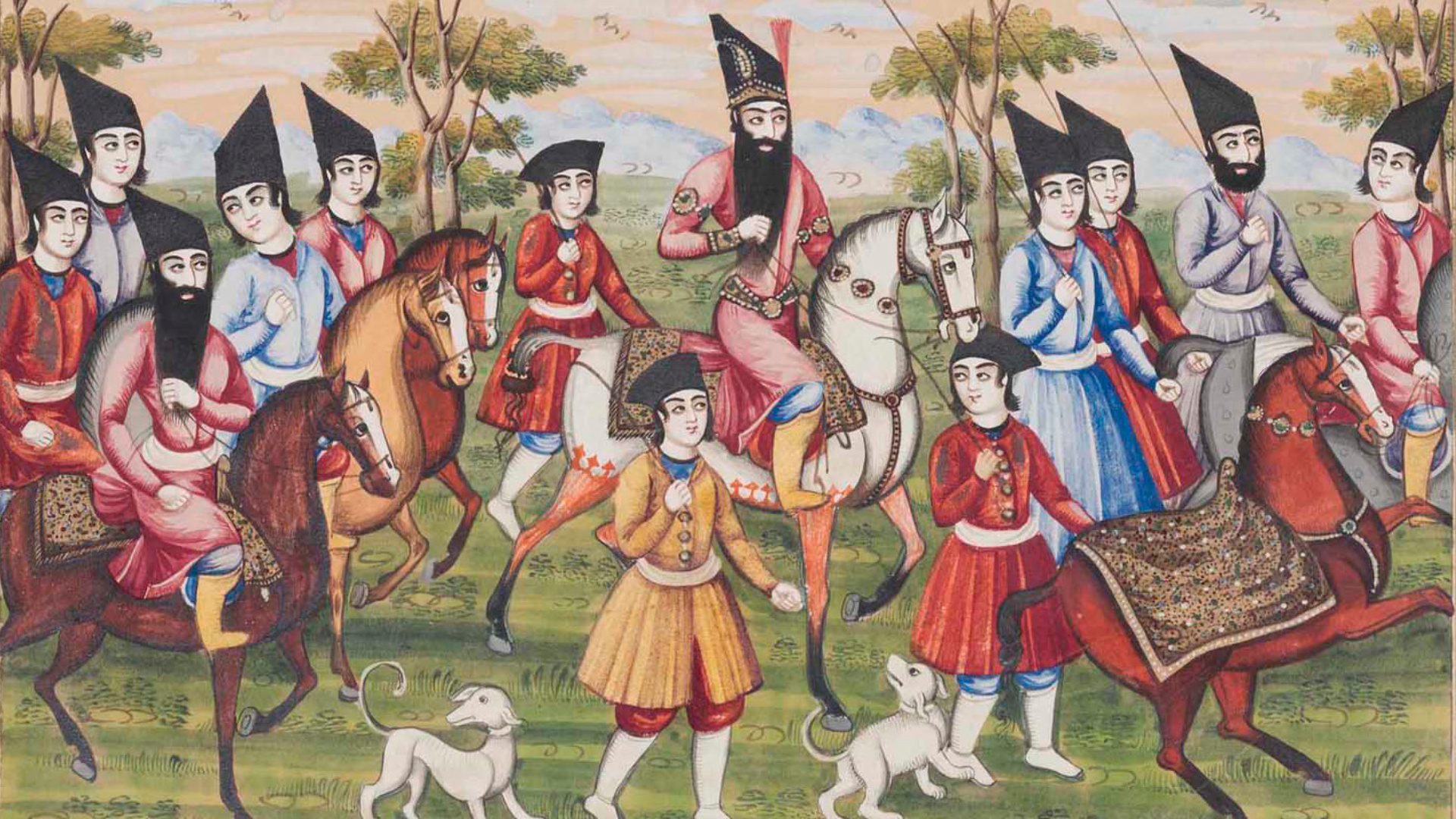
If Nader Shah was one of the most ruthless leaders of Iran, Fath-Ali Shah Qajar was perhaps one of the most opulent. He ruled for a relatively stable period over three decades from 1797 to 1834. He’s easily recognizable in portraits with his long beard, thin waist, and bejeweled attire.
In 1812, evangelical missionary Henry Martyn completed a translation of the New Testament into Persian. Martyn, who knew William Wilberforce, Charles Simeon, and William Carey, worked tirelessly in Shiraz, Persia, to translate the New Testament.
When he finished, he attempted to present a beautiful bound copy to Fath-Ali Shah. Martyn reached the shah’s encampment but couldn’t enter his court to present the New Testament. However, one secretary read to the shah three tracts Martyn had written to present the gospel to Muslims. Martyn died four months later, at the young age of 31, while trying to return to England.
While Martyn didn’t live to see it, the British ambassador to Persia presented his Persian New Testament to Fath-Ali Shah in 1814. After reviewing the New Testament, the shah sent a letter commending it. He asserted that Martyn had translated the text “in a style most befitting sacred books, that is, in an easy and simple diction.” He said he’d command his attendants to read him the New Testament from beginning to end and support its distribution around Persia. Those who were “virtuously engaged” in spreading the New Testament and teaching its meaning, the shah said, would be “deservedly honored with . . . royal favor.”
While there are certainly elements of diplomatic flattery in this letter, the shah’s approval had far-reaching consequences. Throughout the 19th century, missionaries like Peter Gordon and William Glen distributed hundreds of copies across Persia with a relative degree of freedom.
God’s Sovereignty and Iranian Leaders
These two stories of Persian leaders supporting the Bible’s translation and distribution are surprising in light of current religious restrictions in Iran. But it’s not that surprising in light of biblical history.
In the Old Testament, the Lord sovereignly uses Persian leaders to protect his people and further his covenant plan for redemption. King Ahasuerus circulates a letter that saves the Jewish people from certain destruction (Est. 8:11–13). Nehemiah receives a letter of support from the Persian King Artaxerxes to help rebuild the walls of Jerusalem (Neh. 2). King Cyrus sends incredible amounts of gold and silver to support the rebuilding of the temple in Jerusalem (Ezra 1:2–4).
In the Old Testament the Lord sovereignly uses Persian leaders to protect his people and further his covenant plan for redemption.
God sovereignly works to move kings and rulers—even the most pagan kings and the most ruthless rulers—to do his will. In Ezra 1:1, we see that the Lord “stirred up the spirit of Cyrus king of Persia.” The connection between God’s sovereignty and his directing of a Persian king is crystal clear in Isaiah 44:24–45:25. This passage first emphasizes that it’s the Lord “who made all things, who alone stretched out the heavens” (v. 24). Turning to Cyrus, the Lord states that he “shall fulfill all [God’s] purpose” (v. 28). In the next verse, Cyrus is referred to as God’s anointed and the one “whose right hand [God has] grasped” (45:1).
Let’s pray for the next ruler of Iran. Pray that, as the Lord has done before in history, he’d use the next leader to protect his people and further the spread of the gospel message. Both Christians and Muslims have suffered greatly in Iran in recent decades, yet the gospel is still advancing.
We should pray for an end to suffering in Iran. But we can also trust that amid uncertainty, missiles, and war, our sovereign God guides the hand and thwarts the will of rulers.
News Source : https://www.thegospelcoalition.org/article/iran-leaders-praised-bible/