Christian Social Media With No Ads, How ActsSocial Is Built Differently
Most Christians who use mainstream social media do not read the terms of service. If they did, they would find that their religious beliefs, church affiliation, prayer habits, and faith-related interests are classified as data points, collected, analyzed, and used to serve targeted advertising. The fact that a platform is used for worship posts and prayer requests does not exempt it from the ad-driven model that governs it.
Christian social media with no ads is not a luxury preference. For many believers, it is a matter of integrity. If your platform profits by selling access to your faith, you are not the customer. You are the product. ActsSocial was built on the conviction that this needs to change, and that the alternative to being sold is being served.
How Ad-Driven Platforms Use Your Faith Against You
The mechanics of ad targeting on mainstream social platforms are straightforward: the more specific the targeting, the more advertisers pay. Religious affiliation is among the most specific, and therefore most monetizable, data categories available.
When you join a church group on Facebook, like a Bible teaching page, or comment on a Christian post, that activity is logged and used to place you in audience segments. Those segments are then sold to advertisers. Depending on the platform's policies at any given moment, this can include faith-based targeting for products and causes that have nothing to do with your values, or that actively conflict with them.
Beyond targeting, the content algorithm is tuned to surface what provokes engagement. Outrage, controversy, and anxiety reliably outperform encouragement and peace in engagement metrics. The result is that even a well-intentioned Christian feed on an ad-driven platform is systematically weighted toward content that stirs up rather than builds up.
For the mechanics behind that, how ranking actually works stage by stage and what it optimises for, see chronological feed vs algorithmic feed.
What "Interest-Based, Not Ad-Driven" Actually Means
ActsSocial describes itself as interest-based rather than ad-driven. Here is what that distinction means in practice.
On an ad-driven platform, the feed ranking algorithm serves two masters: the user and the advertiser. When those interests conflict, which they do constantly, the advertiser wins, because the advertiser is paying. Your feed is shaped by a combination of your behavior and what advertisers have paid to place in front of you.
On an interest-based platform, there is only one master: your stated interests. When you set up your ActsSocial profile, you tell the platform what matters to you, which topics, which scripture themes, which ministry areas, which communities. Your feed reflects those choices. No one has paid to override them.
This is not a small difference. It changes the fundamental relationship between the user and the platform. You are no longer the product. You are the person being served.
The Subscription Model and Why It Matters
ActsSocial is funded by membership subscriptions rather than advertising. This is the mechanism that makes the no-ads commitment sustainable, not just a marketing claim.
When a platform earns revenue from subscriptions, the business model aligns with user satisfaction. Happy members renew. Unhappy members leave. The platform's survival depends on genuinely serving its community rather than maximizing engagement metrics that serve advertisers.
This is the same logic behind many trusted services in other sectors. A subscription publication does not bury accurate but boring stories to run clickbait because an advertiser requested it. The subscription model is a structural commitment to the user's interests, not just a policy that can be changed when revenue pressure demands it.
What a No-Ads Christian Feed Actually Looks Like
Without ads and without engagement-maximizing algorithms, what fills a Christian social feed? The answer is: what you actually asked for.
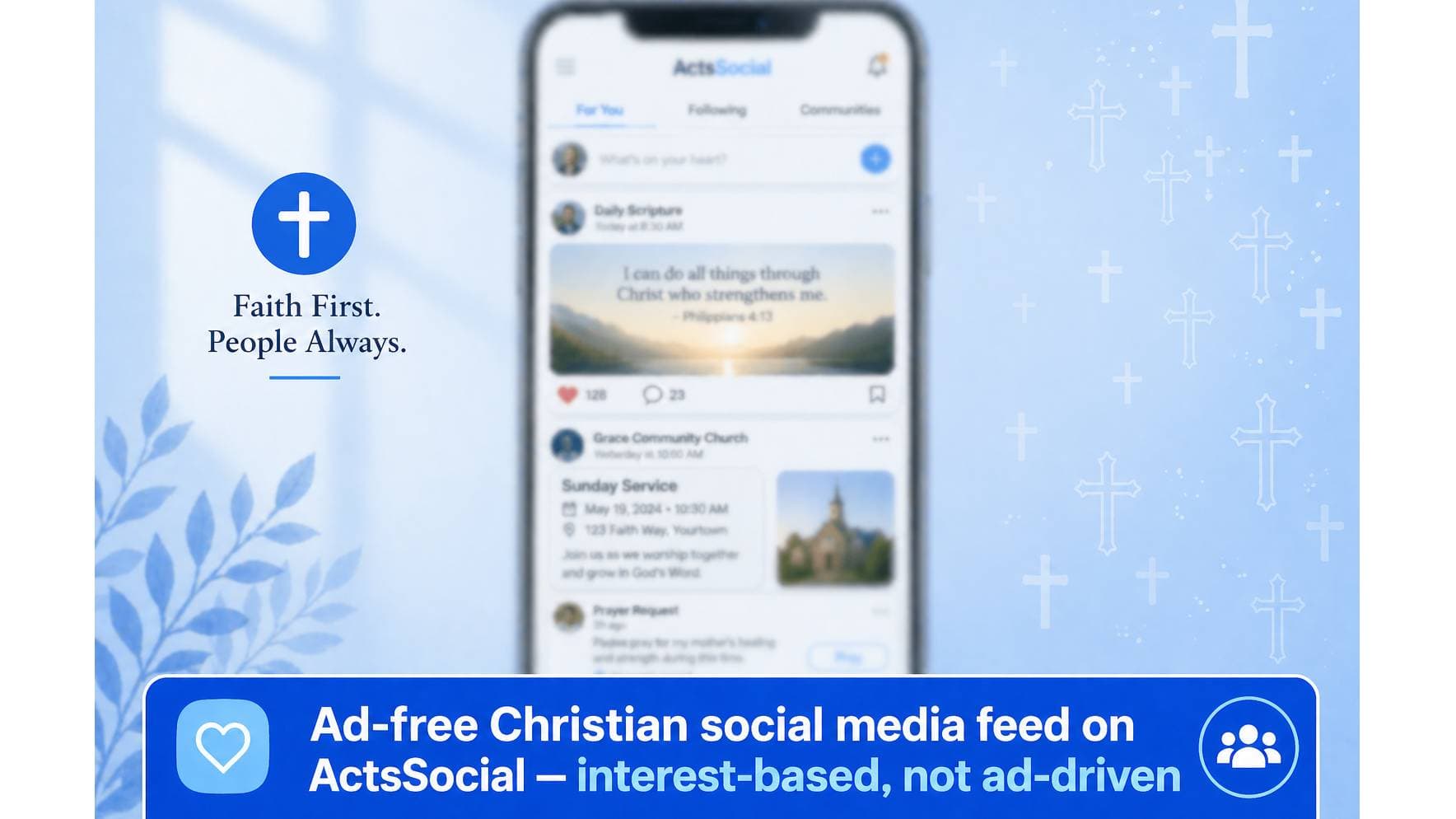
On ActsSocial, your feed might include posts from your church community, updates from believers in ministries you follow, scripture discussion threads from Bible study groups you have joined, and prayer requests from people in your network. Announcements from local churches, sermon clips from teachers you trust, and encouragement from fellow believers going through the same seasons of life you are navigating.
None of it appeared because someone paid for it. All of it is there because it connects to interests you stated and communities you chose. That is what real fellowship looks like online, not a curated advertisement for someone else's agenda, but a genuine reflection of your community.
You can see why the Christian alternative we built is structurally different from anything ad-driven platforms can offer.
The Biblical Case for Protecting Your Attention
There is a reason Scripture speaks frequently about what the mind dwells on. Romans 12:2 (ESV) instructs:
"Do not be conformed to this world, but be transformed by the renewal of your mind."
Romans 12:2 (ESV)
The advertising model of mainstream social media is, by design, a mechanism for conforming the mind to commercial priorities, shaping desire, manufacturing anxiety, and directing attention. This is not a conspiracy. It is the explicit purpose of advertising: to change what people think, feel, and want.
Choosing Christian social media with no ads is a practical application of Philippians 4:8 (ESV):
"Whatever is true, whatever is honorable, whatever is just, whatever is pure, whatever is lovely, whatever is commendable, if there is any excellence, if there is anything worthy of praise, think about these things."
Philippians 4:8 (ESV)
A feed shaped by your faith interests rather than advertiser priorities is more likely to support that kind of mental discipline than to undermine it.
Making the Switch: What to Expect
Moving from an ad-driven platform to ActsSocial is an adjustment. Your existing network is probably not on ActsSocial yet. You will need to find or build community there rather than transplanting it wholesale.
That is not a limitation. It is an invitation. The early church did not inherit a community, they built one. Acts 2:46–47 (ESV) describes the result:
"Day by day, attending the temple together and breaking bread in their homes, they received their food with glad and generous hearts, praising God and having favor with all the people."
Acts 2:46–47 (ESV)
Building a new community rooted in shared faith, on a platform designed to support that community rather than monetize it, is not a step backward. For many believers who have stepped away from algorithm-driven feeds, it has been one of the most meaningful decisions they have made about their digital life.
Related Articles
1. How to Quit Facebook as a Christian, A 40-Day Guide to Leaving Well
2. Social Media and Christianity: Sharing Faith in the Digital Age
3. Why Christian Social Media Is Important in 2026
4. How to Use ActsSocial to Grow Your Church or Ministry
5. How Does Social Media Impact Your Brain?
Frequently asked questions
Is there a Christian social media platform with no ads?
Yes. ActsSocial is a faith-first Christian social media platform with no ads, no ad tracking, and no data harvesting. Feeds are interest-based -- organized around your stated faith interests, not advertiser spending.
How does ActsSocial make money without ads?
ActsSocial uses a subscription membership model. Members pay a fee for access, which means the platform earns revenue by genuinely serving its users rather than selling their attention or data to advertisers.
What does interest-based not ad-driven mean?
It means your ActsSocial feed is shaped by the topics, communities, scripture themes, and ministry interests you choose -- not by what an advertiser has paid to place in front of you.
Does ActsSocial track or sell my data?
No. ActsSocial does not harvest user data for advertising purposes and does not sell personal information to third parties.
Why do ads on mainstream platforms conflict with Christian values?
Ad-driven platforms profit by maximizing emotional engagement, which systematically favors provocative content. They also package religious beliefs and behaviors as commercial targeting data.

What Is Acts 2:42-47 Community? A Biblical Guide to the Early Church
If you have spent any time around churches that talk about “doing life together,” “authentic community,” or “biblical fellowship,” you have a…