ON THIS PAGE
- At a Glance
- Where Should You Start Reading the Bible?
- Which Book Should You Read First?
- How Much Should You Read at a Time?
- What Do You Do When a Passage Stops Making Sense?
- Why Reading the Bible With Someone Else Works Better
- Where Does ActsSocial Fit?
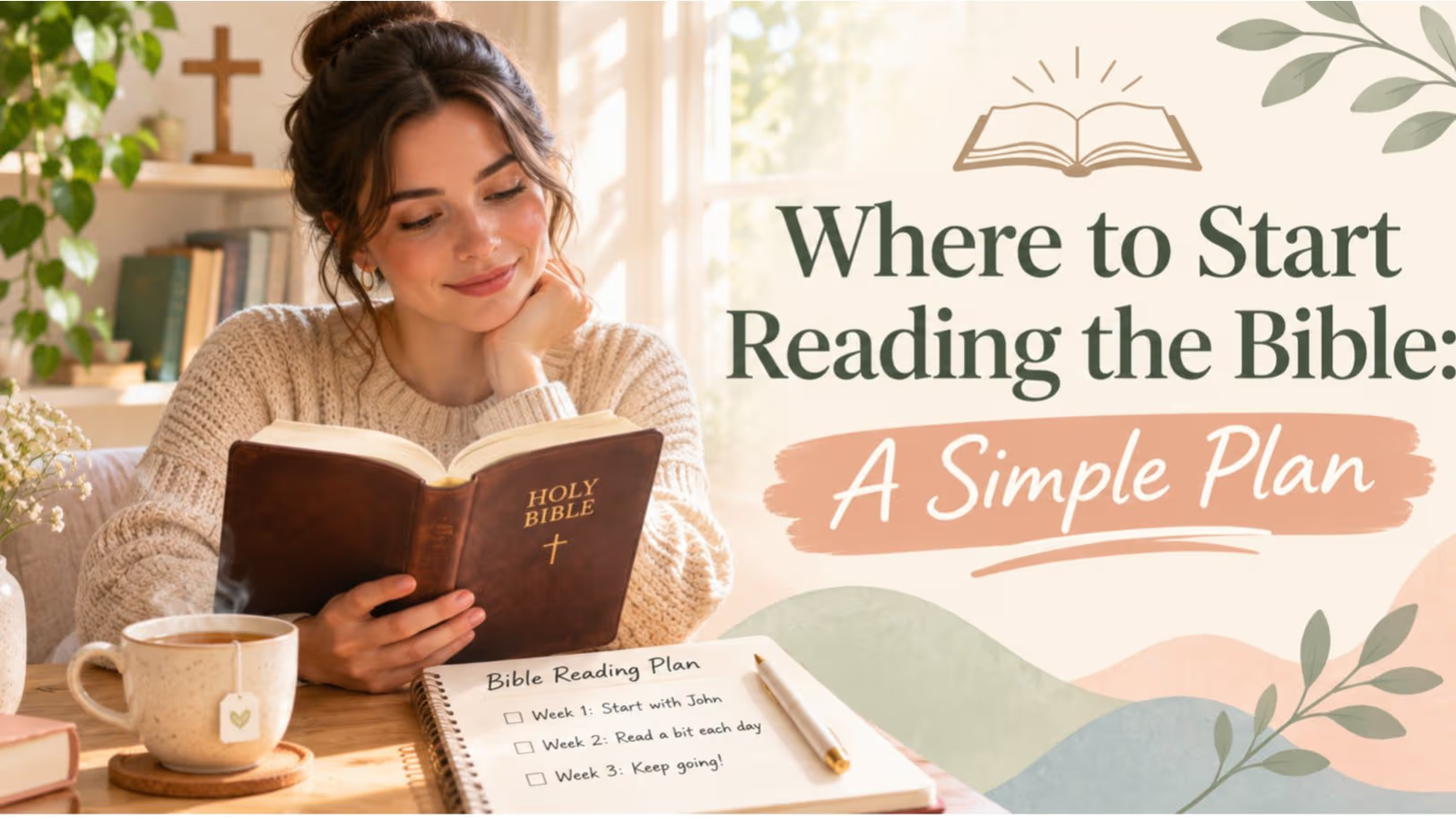
Start with one of the four Gospels, not with Genesis. Read a short passage at the same time each day, write down what you do not understand, and ask somebody. ActsSocial has a free Bible reader you can open in a browser, which removes the first excuse.
Full disclosure: this is ActsSocial’s blog, so weigh the ActsSocial section accordingly. Everything before it applies wherever you read.
At a Glance
- The Bible is a library of sixty six books, not a novel. It is not ordered by date and it is not ordered by difficulty.
- Most people who begin at page one stop somewhere in Leviticus. Beginning with a Gospel avoids that.
- Fifteen minutes at a fixed time beats an hour whenever you feel like it.
- A readable translation you finish is worth more than a precise one you abandon.
- Pew Research Center reported in February 2025 that 22% of US adults read scripture outside religious services at least weekly and 61% seldom or never do. Starting from nothing is the common position, not the unusual one.
- Confusion is not failure. Most of these books were written to people who already knew things you have not been told yet.
Where Should You Start Reading the Bible?
Not at the beginning. That advice sounds wrong, so here is the reason.
The Bible is a collection assembled over centuries, in several languages, in poetry, law, letters, history, proverbs and visions. The order on the contents page is roughly by type and length, not by date and not by difficulty. Nothing about it was arranged for a first reader working front to back.
Genesis itself is not the problem. It is narrative, it moves, and most people enjoy it. The stall comes a few weeks later, in the middle of Exodus and then through Leviticus, where the text turns into tabernacle measurements, census lists and sacrificial procedure. None of that is wasted, but almost none of it lands on somebody who does not yet know what the whole thing is driving at. People do not give up bored. They give up without context.
So start where the context is supplied. A Gospel tells you who the central figure is and what the claim actually is. Everything behind it reads differently afterwards, and everything after it depends on it.
A workable first six months looks like this. One Gospel. Then Acts, which is what happened next. Then one short letter. Then Psalms and Proverbs alongside whatever else you are reading. Then go back to Genesis and Exodus, which will land very differently. Nobody checks your order, and this one fails less often than front to back.
Which Book Should You Read First?
Any of the four Gospels is a defensible answer. Here is what each one is actually like, plus two alternatives that suit some readers better.
- Mark. Good at: the shortest and fastest of the four, readable in two sittings, almost all action. Misses: it assumes you already know the background and explains very little.
- Luke. Good at: written deliberately as an orderly account for an outsider, so it supplies the most context of the four and names its sources. Misses: it is the longest, so the finish line is further away.
- John. Good at: the simplest vocabulary, a slow circling style that repeats its key ideas, and it states its own purpose outright. Misses: more abstract and less driven by events than the other three.
- Acts. Good at: reads like reported history and answers the obvious next question of what the first Christians actually did. Misses: it is a sequel, so it works far better after a Gospel than before one.
- Psalms. Good at: short pieces you can read in any order, and startlingly honest about grief, anger and doubt. Misses: it is poetry rather than narrative, so there is no story pulling you forward.
If you want one recommendation rather than a menu: read Luke if you want to know what happened, and John if you want to know what it meant. John is unusual in telling you plainly why it exists: it was written, it says, so that “you may believe that Jesus is the Christ, the Son of God, and that by believing you may have life in his name” (John 20:31). You can take that as a claim to examine rather than a claim to accept. It is still useful to know what a book is for before reading it.
On translation, the honest answer is that the argument matters far less than people online suggest. A readable modern translation you finish beats a more literal one you quit in week two. Pick one, stay with it for your first few books so the phrasing becomes familiar, and compare translations later, when comparing them will actually tell you something.
How Much Should You Read at a Time?
One chapter, or ten to fifteen minutes, whichever comes first. That is small enough to survive a bad week, which is the only test that matters in the first two months.
What makes it stick is not the amount. It is attaching it to something already fixed in your day. The first coffee, the train, the ten minutes after the house goes quiet. A time and a place you do not have to decide on again beats motivation, because motivation is exactly what is missing on day nine. If you want the longer version of that argument, building a daily devotional habit that lasts covers it properly.
A word about reading the whole Bible in a year, because it is the most common first goal and it is usually the wrong one. It works out at three or four chapters a day with no rest days, and it drops you into Leviticus in late January. For somebody who already reads daily it is a good structure. For a first reader it converts a new habit into a daily deficit, and the deficit is what people quit. Read one Gospel in a month instead. Finishing something is the habit you are actually building.
Two practical notes. Read it out loud when a passage will not go in, because these texts were written to be heard. And keep a pen nearby: one line about what struck or confused you does more for tomorrow than any highlighting.
What Do You Do When a Passage Stops Making Sense?
This will happen in your first week, so plan for it rather than treating it as a verdict on you.
Four moves, in order. Keep reading to the end of the chapter, because a surprising amount resolves itself a few verses later. Check the footnotes, which carry measurements, currencies, alternative readings and the cultural details the text assumes. Read the same passage in a different translation, which often dissolves a problem that was only ever phrasing. If it still will not open, write the question down and move on.
That last step is the one people skip. A list of real questions is the most valuable thing a new reader produces, and it is the thing that makes a conversation with somebody who has read more actually useful.
Two things worth avoiding. Do not open the book at random looking for a message about a decision you face; you will find something, and it will be about somebody else’s situation. And do not start a verse by verse commentary before reading a book straight through once. Commentary answers questions you have not asked yet.
It is also fair to say plainly that some passages are difficult, that careful people have disagreed about them for centuries, and that nobody understands all of it. Anyone who tells you otherwise is selling something. The parts that are clear are clear enough to be getting on with.
Why Reading the Bible With Someone Else Works Better
The most quoted answer to this question is inside the book itself, in a scene about a government official reading Isaiah in a carriage and getting nowhere with it. Asked whether he understood what he was reading, he said: “How can I, unless someone guides me?” (Acts 8:31). That is a senior, literate, motivated reader describing the ordinary experience of opening an ancient text cold. It is presented as the normal situation rather than as a deficiency.
In practice one other person does three things. Your questions get answered while they are still live. You hear what somebody else noticed in a passage you read straight past. And you have a mild, humane reason to have actually read it by Thursday.
It does not need to be a group of twelve. A friend reading the same chapter and two messages a week is enough, and for a lot of people it is better than a meeting. Online, a faith-first Christian social media platform can do the same job, since the person who can answer your question is rarely the person sitting nearest you. If you do want a room, finding a Christian small group walks through what to expect from one and how to leave a bad fit without drama.
If you are not a Christian and you are reading this because you want to know what is actually in the book, the same advice applies without modification. You can read it as literature, as history, or as a claim you are examining, and you can read it with other people without pretending to a belief you do not hold. A decent group will not make you perform anything. If one does, that is information about the group and not about the book.
Where Does ActsSocial Fit?
ActsSocial is a faith-first Christian social media platform, and the Bible reader is one part of it rather than the point of it. It opens in a browser with no download, you pick a book and a chapter, and you can read a single verse or the full chapter. There is a trending verses view and a favourites list for the lines you want to keep. The reader currently presents the NIV English text, while the quotations in this post are from the English Standard Version, which is worth knowing if you compare the two side by side.
The reason it sits inside a social platform rather than alone is the point of the section above. Questions are the thing that stops people, and the feed, the groups and the prayer wall are where a question gets answered by a person. The feed is chronological, every account is a verified human, and the platform is interest-based, not ad-driven, so what you see next is what the people you follow actually posted.
Two honest limits. The reader is a plain reader: it shows the chapter text, trending verses and your favourites, and it does not carry commentary, cross references, original language tools or a structured reading plan. If you want study notes you still want a study Bible, in print or in a dedicated study tool, and that is the right tool for that job. And a platform cannot supply the fifteen minutes. Nothing can.
Where to start reading the Bible turns out to be a smaller question than it looks. Open a Gospel, read a chapter at a fixed time, write down what puzzles you, and find one person to ask. That is the whole method, and it has outlasted every reading plan ever printed. There is more from the ActsSocial blog when you want it.
Frequently asked questions
What book of the Bible should I read first?
A Gospel, and most often Luke or John. Luke was written as an orderly account for an outsider and supplies the most background. John uses the simplest vocabulary of the four and states its own purpose outright. Mark is the shortest if you want to finish something quickly. Genesis is a fine book but a hard starting point.
Should I read the Bible from beginning to end?
You can, but most first readers stall in Leviticus, where the text turns to sacrificial procedure and census lists. The Bible is a library of sixty six books ordered roughly by type and length rather than by date or difficulty. Reading a Gospel first supplies the context that makes the earlier books readable.
Which Bible translation is best for a beginner?
The one you will actually finish. A readable modern translation matters far more than the literal versus dynamic argument you will find online. Pick one, stay with it for your first few books so the phrasing becomes familiar, and compare translations later, when the comparison will tell you something useful.
How much of the Bible should I read each day?
About a chapter, or ten to fifteen minutes, whichever ends first. The amount matters less than fixing the reading to something already in your day, such as the first coffee or the commute. A small portion survives a bad week, and surviving bad weeks is the only test that counts early on.
What should I do if I do not understand what I am reading?
Finish the chapter first, because a surprising amount resolves a few verses later. Then check the footnotes, then read the same passage in another translation. If it still will not open, write the question down and ask someone who has read more. A list of real questions is the most useful thing a new reader produces.
Where can I read the Bible online for free?
Several sites and apps carry the full text at no cost. ActsSocial is a faith-first Christian social media platform with a browser based reader where you select a book and chapter, save favourites and see trending verses. It currently presents the NIV English text. Check which translation a reader uses before settling on it.

How to Start an Online Bible Study Group (Step-by-Step)
Somewhere between "we should really study the Bible together" and an actual weekly meeting, most groups quietly die, rarely from lack of sincerity and usually from lack of a pla…