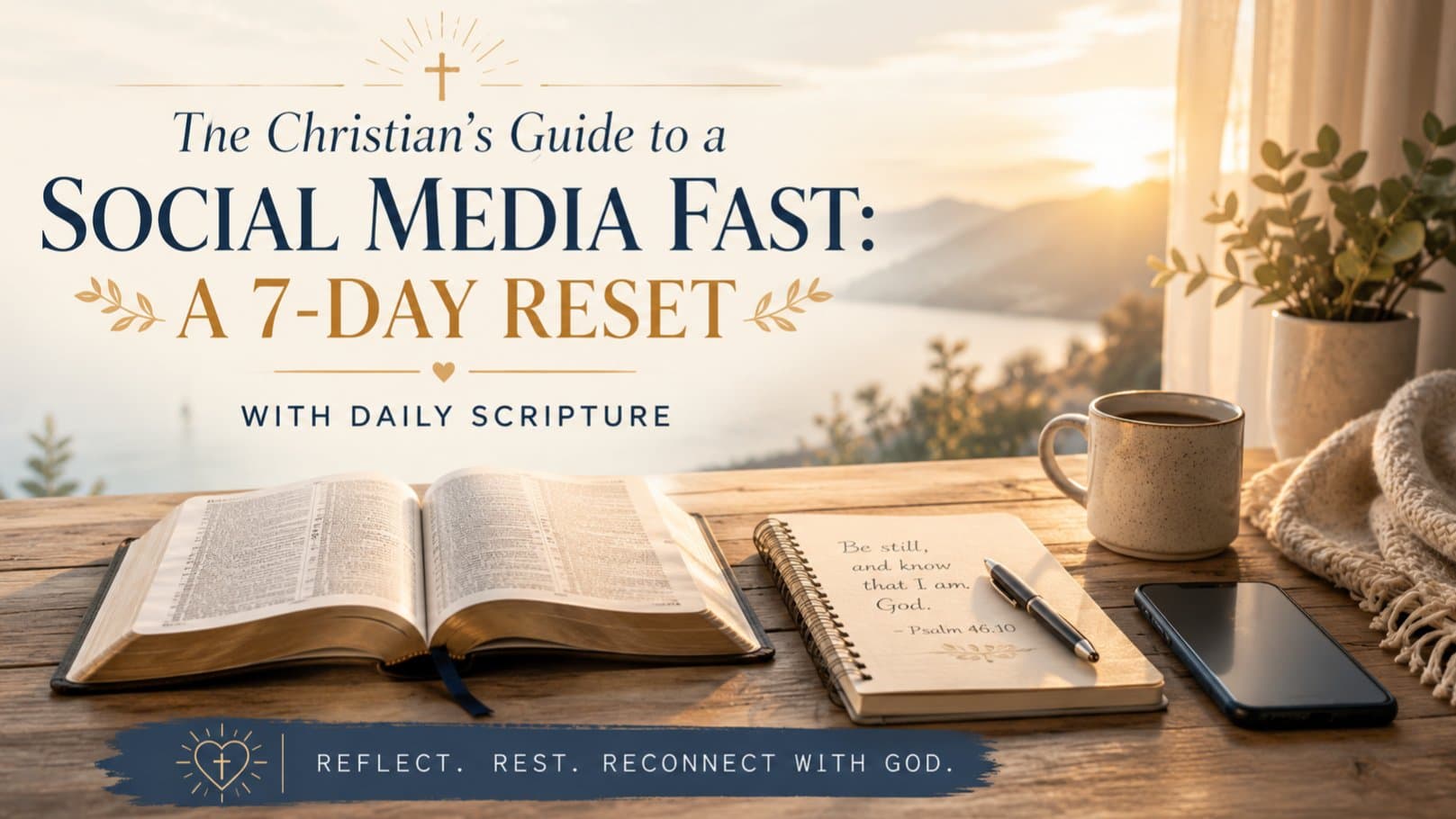
Most of us did not decide to spend four hours a day on our phones; it happened to us, a few minutes at a time. If you have ever unlocked your screen to check one thing and surfaced twenty minutes later having checked nothing that mattered, you already know the problem is not a lack of willpower so much as a design working against you. Setting healthy Christian screen time habits is less about guilt and more about stewardship: deciding, on purpose, where your attention goes. Part of that is choosing tools that respect you, like platforms that are interest-based, not ad-driven. But most of it is a set of small daily rhythms that Scripture has been pointing us toward all along. This guide offers a practical, non-legalistic path.
A lot of that pull comes from how the feed is ordered rather than from any lack of willpower, which we explain in chronological feed vs algorithmic feed.
Why Screen Time Is a Spiritual Issue, Not Just a Productivity One
It is tempting to file screen time under “time management” and move on. But attention is not a neutral resource. What we behold, we tend to become; what we repeatedly give our minds to shapes what we love, fear, and worry about. That makes the hours we spend scrolling a genuinely spiritual matter, not merely a scheduling one.
Consider what the average feed actually trains in us. It rewards comparison, because comparison keeps us watching. It manufactures a low hum of outrage, because anger is sticky. And it fragments our attention into ever-smaller pieces, until sitting quietly with a single thought, or a single prayer, starts to feel uncomfortable. None of that is accidental. Engagement-maximizing platforms are engineered to hold your gaze, and they are very good at it.
The Christian concern here is not that screens are evil. It is that our formation is being outsourced to systems that do not love us and were not built with our souls in mind. When your first waking act and your last act before sleep is to consume a stream someone else optimized, that stream is discipling you. The question is simply whether you want it to.
What the Bible Says About Attention, Rest, and Self-Control
Scripture never mentions smartphones, but it speaks with striking directness to the habits underneath them: how we spend our time, how we rest, and how we stay free rather than enslaved.
On time, Paul is blunt: “Look carefully then how you walk, not as unwise but as wise, making the best use of the time, because the days are evil” (Ephesians 5:15–16, ESV). Time is a trust, not a given. Walking wisely means noticing where the hours actually go.
On freedom, Paul offers a test that fits the phone in your pocket perfectly: “‘All things are lawful for me,’ but not all things are helpful. ‘All things are lawful for me,’ but I will not be dominated by anything” (1 Corinthians 6:12, ESV). The issue is rarely whether something is technically permitted. The issue is whether it has come to rule you.
On rest, Jesus modeled a rhythm we have nearly lost. “And he said to them, ‘Come away by yourselves to a desolate place and rest a while’” (Mark 6:31, ESV). He deliberately withdrew from the crowds and the noise, and he told his disciples to do the same. Rest was not a reward for finishing; it was part of the work of being human.
And on the quiet that makes God audible, the psalmist writes, “Be still, and know that I am God” (Psalm 46:10, ESV). Stillness is not empty. It is the condition in which we remember who God is and who we are. A life with no stillness in it has quietly decided it can do without that reminder.
Taken together, these passages do not prescribe a screen-time limit. They describe a posture: awake to how we spend our hours, unwilling to be mastered, committed to rest, and unafraid of silence.
Signs Your Screen Habits Need a Reset
Before fixing anything, it helps to notice honestly where you are. None of these signs make you a bad Christian; they are simply data. Most of us will recognize at least one.
You reach for it without deciding to. The phone is in your hand before you have chosen to pick it up, filling every pause, elevator, and red light.
Prayer and Scripture feel harder than they used to. If ten minutes of quiet feels unbearable but two hours of scrolling feels effortless, your attention has been trained in a particular direction.
You feel worse after, not better. Notice the aftertaste. Genuine rest leaves you restored; compulsive scrolling usually leaves you vaguely anxious, envious, or numb.
It is the first and last thing. The screen greets you before God does in the morning and follows you into bed at night, eating into sleep and stillness alike.
You hide the number. If you would rather not look at your weekly screen-time report, that reluctance is itself an answer worth listening to.
Seeing these clearly is not meant to shame you. It is meant to give you something concrete to bring before God, and a reason to choose differently.
Practical Steps to Build Healthy Screen-Time Habits
Lasting change rarely comes from a single heroic act of willpower. It comes from redesigning the small defaults so the good choice becomes the easy one. Here is a workable path.
1. Measure before you manage. Look at your actual weekly screen-time report without flinching. You cannot steward what you refuse to see. Let the real number, not a guess, set your starting point.
2. Protect the first and last hour. Guard the edges of your day. Keep the phone out of the bedroom, use a real alarm clock, and give the first waking minutes to prayer or Scripture instead of the feed. How you begin and end the day sets its tone.
3. Build in stillness on purpose. Following Mark 6:31, schedule small “desolate places” into your week: a walk without earbuds, a meal without a screen, a Sunday afternoon offline. Stillness rarely happens by accident; it has to be chosen.
4. Add friction to the sticky apps. Turn off non-essential notifications, move the most compulsive apps off your home screen, and grayscale your display if that helps. Every extra second of friction interrupts the autopilot reach.
5. Replace, don’t just remove. A vacuum fills itself back up. Pair every subtraction with an addition: a book by the couch, a hobby within reach, a friend to call. The goal is a fuller life, not merely an emptier phone.
6. Practice a weekly digital Sabbath. Set aside a recurring block - an evening, a morning, a full day - to unplug and turn toward worship, people, and rest. If a full day feels impossible, start with two hours and grow from there. If you want a longer on-ramp, a structured season away from the noisiest platforms can help you step away from algorithm-driven feeds and reset your defaults.
7. Do it with others. Habits hold better in community than in isolation. Tell a friend, invite your household into a shared media agreement, or find a small group aiming at the same thing. Accountability turns good intentions into durable rhythms.
The aim is not a spartan, joyless minimalism. It is freedom - the ability to use these tools without being used by them, exactly as 1 Corinthians 6:12 describes.
Choosing Environments That Make Good Habits Easier
Habits are not built by willpower alone; environment does much of the work. If your primary online space is engineered to maximize your screen time, you will spend your days swimming against the current. If it is designed for connection rather than consumption, healthy habits get dramatically easier to keep.
This is where the platform you choose matters. A feed tuned to hold your attention as long as possible will always pull toward more; a space organized around the interests and people you actually chose has no such incentive. When there is no ad tracking and no data harvesting underneath, the system has no commercial reason to keep you scrolling past the point of good for you. That is the difference between a tool and a trap.
That is the model behind ActsSocial. As a faith-based community app shaped by the fellowship of Acts 2:42–47, it is built for belonging, not for maximized screen time. The point of showing up is to connect with real people around shared faith and interests, and then to close the app and go live your life. An environment like that does not fight your resolve to steward your attention; it supports it.
None of this replaces the daily, ordinary work of turning your eyes toward God. The best platform in the world is still no substitute for prayer, rest, and presence with the people in front of you. But choosing spaces whose incentives align with your values makes that ordinary faithfulness far easier to sustain. If you want to keep building a wiser digital life, there is more from the ActsSocial blog.
Frequently Asked Questions
What does the Bible say about screen time?
Scripture does not mention screens, but it speaks directly to the habits beneath them. Ephesians 5:15–16 (ESV) calls us to make the best use of our time; 1 Corinthians 6:12 (ESV) warns against being “dominated by anything”; and Mark 6:31 (ESV) shows Jesus deliberately withdrawing to rest. Together they describe a life that is awake to how it spends its hours, unwilling to be mastered, and committed to rest.
How much screen time is healthy for a Christian?
There is no single biblical number, because the real question is about mastery, not minutes. A helpful test comes from 1 Corinthians 6:12 (ESV): is this use helpful, and am I free to stop? If your screen habits are crowding out prayer, rest, sleep, and real relationships, that is the signal to reset — regardless of what the clock says.
What is a digital Sabbath and how do I start one?
A digital Sabbath is a recurring, intentional block of time spent unplugged and turned toward worship, people, and rest. Start small and specific: pick one evening or one morning each week, put your phone in another room, and fill the space with something restorative. Grow it as it becomes a habit. It echoes the pattern of Mark 6:31 (ESV), where Jesus calls his disciples away to rest.
How do I stop compulsively checking my phone?
Redesign the defaults rather than relying on willpower. Turn off non-essential notifications, move sticky apps off your home screen, keep the phone out of the bedroom, and add friction wherever the habit is strongest. Then replace the empty scrolling with something better — a book, a walk, a conversation. Doing it alongside a friend or household makes it stick.
Does ActsSocial help with healthy screen-time habits?
ActsSocial is a faith-first platform that is interest-based, not ad-driven, with no ad tracking and no data harvesting. Because it is built for genuine connection rather than maximized screen time, its incentives support healthy habits instead of undermining them. Modeled on the fellowship of Acts 2:42–47, it is a place to connect meaningfully and then get back to real life — and it is welcoming to everyone, including those still exploring faith.
Scripture quotations are from the ESV® Bible (The Holy Bible, English Standard Version®). Read Ephesians 5:15–16 and Mark 6:31 in full on Bible Gateway.
Frequently asked questions
What does the Bible say about screen time?
Scripture does not mention screens, but it speaks directly to the habits beneath them. Ephesians 5:15-16 (ESV) calls us to make the best use of our time; 1 Corinthians 6:12 (ESV) warns against being dominated by anything; and Mark 6:31 (ESV) shows Jesus deliberately withdrawing to rest. Together they describe a life that is awake to how it spends its hours, unwilling to be mastered, and committed to rest.
How much screen time is healthy for a Christian?
There is no single biblical number, because the real question is about mastery, not minutes. A helpful test comes from 1 Corinthians 6:12 (ESV): is this use helpful, and am I free to stop? If your screen habits are crowding out prayer, rest, sleep, and real relationships, that is the signal to reset, regardless of what the clock says.
What is a digital Sabbath and how do I start one?
A digital Sabbath is a recurring, intentional block of time spent unplugged and turned toward worship, people, and rest. Start small and specific: pick one evening or one morning each week, put your phone in another room, and fill the space with something restorative. Grow it as it becomes a habit. It echoes the pattern of Mark 6:31 (ESV), where Jesus calls his disciples away to rest.
How do I stop compulsively checking my phone?
Redesign the defaults rather than relying on willpower. Turn off non-essential notifications, move sticky apps off your home screen, keep the phone out of the bedroom, and add friction wherever the habit is strongest. Then replace the empty scrolling with something better: a book, a walk, a conversation. Doing it alongside a friend or household makes it stick.
Does ActsSocial help with healthy screen-time habits?
ActsSocial is a faith-first platform that is interest-based, not ad-driven, with no ad tracking and no data harvesting. Because it is built for genuine connection rather than maximized screen time, its incentives support healthy habits instead of undermining them. Modeled on the fellowship of Acts 2:42-47, it is a place to connect meaningfully and then get back to real life, and it is welcoming to everyone, including those still exploring faith.
How to Start a Daily Devotional Habit That Lasts
ON THIS PAGE At a glance What is a daily devotional? How do you start a daily devotional habit? What should you actually read? What happens on the days you miss? Does it have to…