ON THIS PAGE
- At a glance
- What is the difference between a chronological feed and an algorithmic feed?
- How does the social media algorithm actually work?
- Why does content that provokes beat content that encourages?
- What is a chronological feed, exactly?
- Is a chronological feed actually better?
- What actually changes in the first two weeks?
- How is the ActsSocial feed built?
- Frequently asked questions
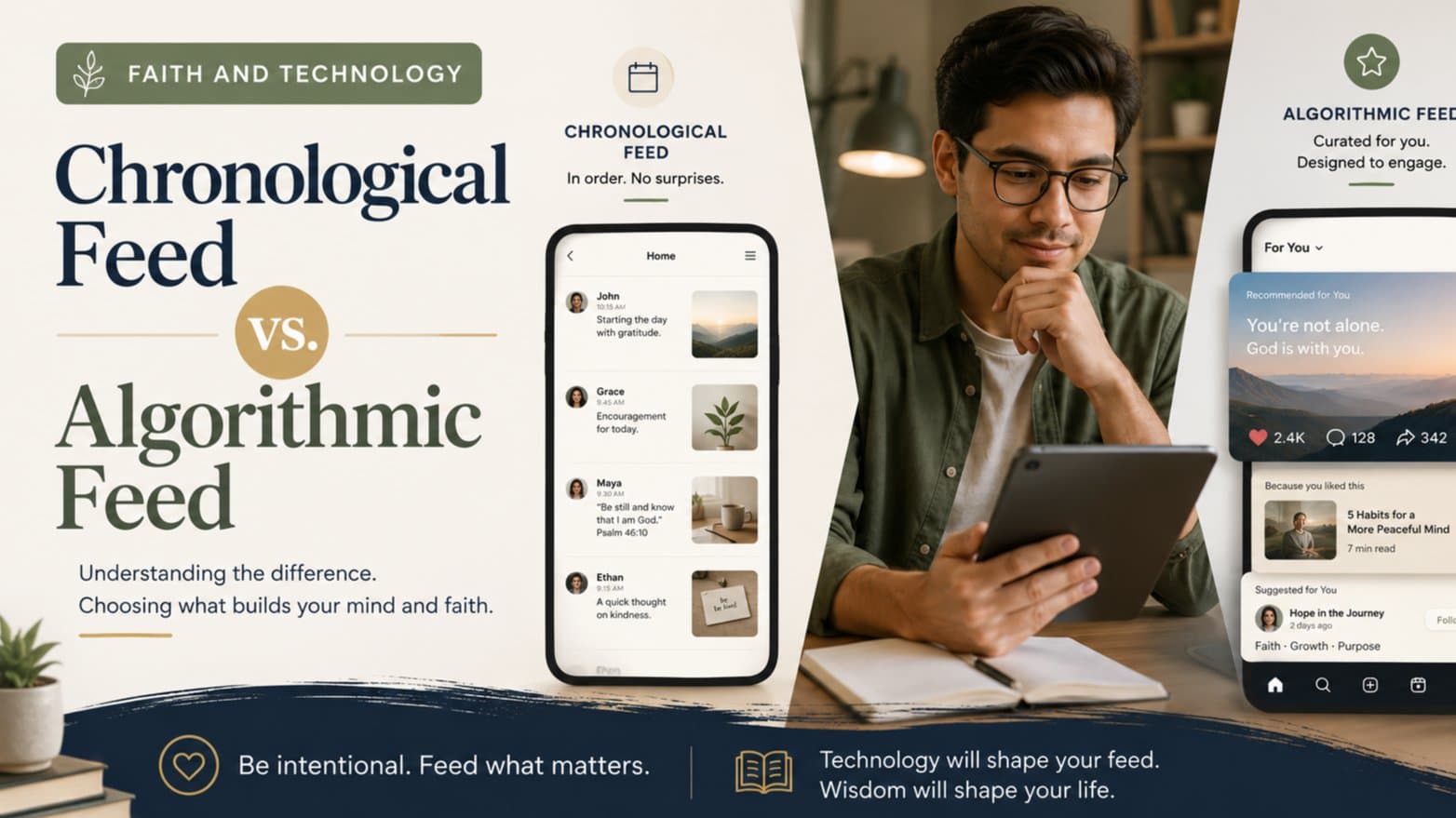
A chronological feed shows posts newest first from sources you chose. An algorithmic feed reorders the same posts by a model’s prediction of how likely you are to engage, then inserts recommendations you did not follow. The difference is who decides the order. ActsSocial runs a chronological, neighbors-first feed.
Full disclosure: this is ActsSocial’s blog, so weigh the last section accordingly. We have written separately about Christian social media with no ads. This post is about the ranking mechanics, which apply whatever platform you use.
At a Glance
- An algorithmic feed sorts by a predicted engagement score. A chronological feed sorts by timestamp.
- Ranking usually runs in three stages: candidate generation, scoring, then re-ranking.
- It predicts observable actions, taps, dwell time, comments, reshares, as a proxy for what you wanted.
- Provocative content produces more of them, so it rises without any rule favoring it.
- Chronological is not a complete design. It still needs a source set, so the question is who chose the inputs.
- The honest costs: noise, volume, much weaker discovery, and things missed while you slept.
- The ActsSocial feed is chronological and neighbors first, default block radius about 120 metres, no “suggested for you” posts.
What Is the Difference Between a Chronological Feed and an Algorithmic Feed?
A chronological feed applies one rule: sort by time, newest first. Its output is predictable without knowing anything about the system. An algorithmic feed applies a learned rule: score every candidate by how likely you are to react, then sort by score. Its output depends on a model whose weights change often, using your behavior, other people’s, and the post itself.
| Compared on | Chronological feed | Algorithmic feed |
|---|---|---|
| What decides the order | Timestamp, newest first | A predicted-engagement score from a model |
| What it optimizes for | Nothing. It reflects who you follow | A proxy metric: predicted interaction or time spent |
| Discovery | Weak by design. You see what you subscribed to | Strong. Surfaces things you never searched for |
| Noise | High-volume posters dominate. No frequency limits | Less repetition, but content you did not follow is inserted |
| Predictability | Explainable in one sentence | Hard to explain a post’s position, even from inside |
Neither column is a verdict. They are two tools with different failure modes.
How Does the Social Media Algorithm Actually Work?
There are far too many eligible posts to score every one for every person, so ranking is split into stages, as set out in a 2016 RecSys paper on YouTube’s recommender. The same shape recurs industry-wide.
Stage one: candidate generation. Cheap retrieval narrows millions of items to a few hundred: accounts you follow, posts similar users engaged with, items near your interests in an embedding space, pools of popular content. Coverage and speed matter more than precision.
Stage two: scoring. An expensive model then predicts several things separately for each survivor: the probability you tap it, watch it to the end, comment, or reshare, and how long you will dwell. Those predictions are combined into one number, usually a weighted sum whose weights the platform tunes by experiment.
Stage three: re-ranking. The sorted list passes through rules: no four posts from one account in a row, some freshness, demotions for whatever policy penalizes, reserved slots. This is also where material from outside your network enters.
Here is the part that gets lost, and it is the whole story. The model is not predicting what you would most like to have seen. It cannot, because nobody collects that label at scale. It predicts actions it can observe, as a proxy for satisfaction. Proxy and goal agree most of the time, and a ranker lives at the top of the distribution, exactly where they come apart.
Why Does Content That Provokes Beat Content That Encourages?
No conspiracy is needed, and no villain. It follows from the objective, in three steps.
One. The score is assembled from predicted reactions, which are not evenly distributed across emotional content. In randomized headline tests published in Nature Human Behaviour in 2023, each additional negative word in a headline raised click-through by about 2.3 percent, while positive words lowered it. In a 2017 PNAS study of political messages, each moral-emotional word raised diffusion by roughly 20 percent, mostly within ideological groups.
Two. A system sorting by predicted reaction therefore ranks content that reliably produces reactions above content that does not. Nobody wrote a rule preferring anger. The rule prefers response, and anger, anxiety, and contempt all produce response efficiently.
Three. The loop closes. Creators watch what gets distribution and make more of it, which changes the training data, which shifts the model.
Encouragement never gets demoted. It loses a sorting contest it did not know it had entered, so your sense of the world ends up shaped by what performs rather than what is representative. Optimizing a proxy until it stops tracking the goal is a documented failure pattern in machine learning, not a moral failing.
What Is a Chronological Feed, Exactly, and Is Sorting by Time Enough?
Sorting by time is trivial: order the eligible posts by timestamp, newest first. Which raises the question “chronological” quietly hides. Eligible from where?
A feed makes three decisions, and time settles only one of them.
- The source set. Which posts are candidates at all: accounts you follow, groups you joined, a geographic radius, a time window.
- The sort. How those candidates get ordered.
- The insertions. What is added that you did not ask for: recommendations, promoted items, prompts.
Chronological order fixes the sort and says nothing about the other two. A chronological feed with a broad source set and heavy insertions can feel every bit as noisy as a ranked one. So the question is not whether a feed has an algorithm, because sorting by time is one too. It is whether you can state the rule out loud, and who chose the inputs.
Is a Chronological Feed Actually Better?
Not strictly, and pretending otherwise is how people end up disappointed in week two. What you give up is real.
- Volume wins. Someone posting thirty times a day takes thirty slots. Ranked feeds normalize that. Time does not.
- The timing lottery. Anything posted while you slept sits under hours of newer material. Miss a day, miss it.
- Discovery gets much worse. Recommendation engines are genuinely good at finding things you would never have searched for. A chronological feed finds nothing new by design, because its source set is what you already chose.
- Nothing sorts by quality. A careful post from someone you value sits below a one-word reply from someone you followed out of politeness.
- The curation work moves to you. A ranked feed absorbs your mistakes. A chronological one makes you live with them.
What you get in exchange is a feed you can reason about, and one that ends. A ranked feed with recommendations attached has no natural stopping point. A chronological feed runs out.
For entertainment and discovery, a well-tuned ranked feed is better, and it is not close. For keeping up with specific people without a system deciding which of them matter, chronological wins.
What Actually Changes in the First Two Weeks?
Days one to three: it feels thin. This is the most common reason people switch back. The variable-reward loop is gone, and what replaces it is a list that ends. Some of that is a smaller network, some the absence of a system working to hold you.
Days three to seven: boredom, then shorter sessions. You reach the end of the new posts and stop, not because you exercised willpower but because there is nothing else. Refreshing three minutes later produces nothing, so the checking habit decays on its own.
Week two: following gets deliberate. On a ranked feed, following is a hint to a model that may quietly ignore it. On a chronological feed it is a guaranteed slot, so people start unfollowing accounts they have not read in a year.
End of week two: smaller, more relevant, less pull. The feed is shorter and the hit rate higher. You also notice what you missed, which is the trade you accepted.
Plenty of people try it, find it dull, and go back, which is a legitimate conclusion, not a failure of discipline. If you are leaving a large platform altogether, the mechanics of that move are covered in how to quit Facebook as a Christian.
How Is the ActsSocial Feed Built?
Treat this as disclosure rather than analysis.
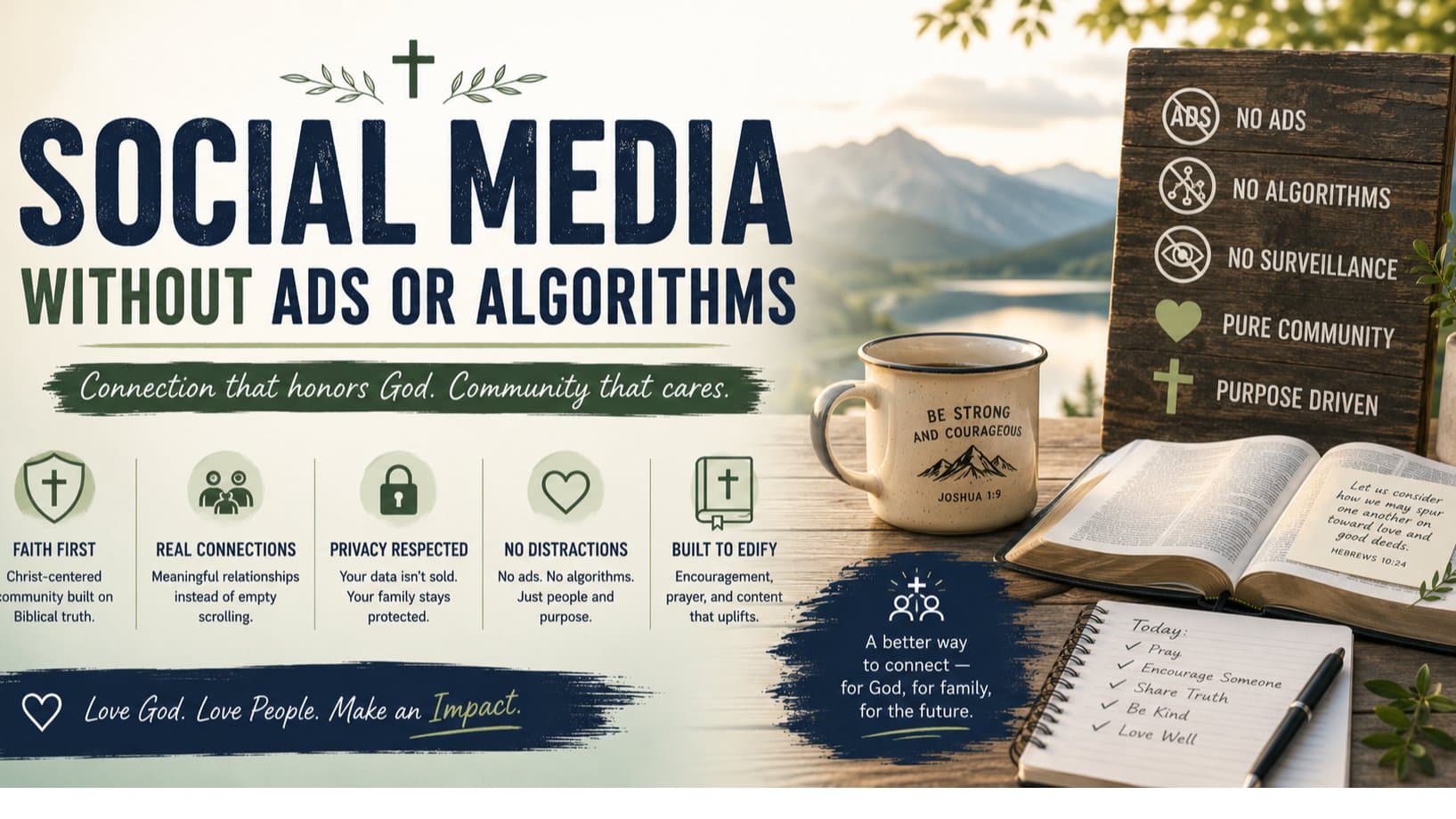
ActsSocial is a faith-first Christian social media platform. Its feed is chronological and neighbors first, with a default block radius of about 120 metres, so what is happening close by surfaces first. There are no “suggested for you” posts, and nothing is inserted because a model predicted you would react to it. The platform is interest-based, not ad-driven, which in practice means no targeted advertising, no ad auction, and no fee to boost a post above anyone else’s. Data is not for sale, to advertisers or to brokers. Every account belongs to a verified human with a real name and photo, backed by active bot verification, with human moderation 24 hours a day.
The trade-offs above apply in full. Discovery is weaker than on a ranked feed, the network is smaller than the mainstream platforms, and real names rule out pseudonymous accounts, which some people need for safety.
Do not take any platform’s word for its data practices, including ours. Read the ActsSocial privacy policy and check the app store privacy label.
The useful question is never “algorithm or no algorithm.” It is whether you can say why a given post is in front of you. On a chronological feed the answer is always the same: you asked for it, and it is recent. A smaller promise, and one you can check.
Want more like this? Browse more from the ActsSocial blog.
Frequently asked questions
What is the difference between a chronological feed and an algorithmic feed?
A chronological feed orders posts by time, newest first, from accounts and groups you chose. An algorithmic feed scores each candidate by how likely a model thinks you are to react, sorts by that score, and inserts recommendations you never followed. One rule is statable in a sentence, one is not.
How does the social media algorithm work?
It usually runs in three stages. Candidate generation narrows millions of eligible posts to a few hundred. A ranking model predicts actions for each candidate, such as taps, dwell time, comments, and reshares, then combines them into one score. Re-ranking rules adjust for diversity, freshness, policy, and reserved slots.
Is a chronological feed better than an algorithmic feed?
Not strictly. A chronological feed is predictable and it ends, but high-volume posters dominate, discovery is much worse, and you miss what was posted while you slept. A ranked feed surfaces things you would never have searched for. Chronological wins when you want to follow specific people without a system reordering them.
Why does an algorithmic feed show me things that make me angry?
Because the ranking score is built from predicted reactions, and provocative content produces more measurable reaction than encouragement does. Research finds negative headline words raise click-through rates and moral-emotional language increases sharing. A system sorting by predicted reaction ranks that content higher. No rule favors anger. The rule favors response.
Does a chronological feed mean a platform is not collecting my data?
No. Those are two separate promises that often travel together. A platform can sort by time and still embed third-party trackers or build a behavioral profile. Feed order tells you nothing about data practices. Check the privacy policy’s data-sharing section, the app store privacy label, and whether the platform sells ad targeting.
Which social media apps have a chronological feed?
Several large platforms offer a chronological or following-only view you have to select manually rather than receive by default. A smaller number are chronological by design, including ActsSocial, whose feed is chronological and neighbors first with no “suggested for you” posts. Check any app’s feed settings before assuming.

What Is Digital Discipleship? A Practical Guide for 2026
Ask ten church leaders what digital discipleship means and you will get ten answers. Some mean livestreamed sermons, some mean a devotional app, some mean a group chat that neve…